
Seven days in Cape Verde can produce very different trips.
One traveller might spend the week on a single island, with very little time lost to transport. Another might visit three islands, take a domestic flight and a ferry, change accommodation several times and still technically have the same seven days.
The difference is the amount of the week actually spent experiencing the islands.
For most first-time trips of seven days and six nights, one or two islands provide the strongest balance. Two offer enough contrast to experience different sides of Cape Verde without turning the holiday into a sequence of check-outs, airports, ports and new arrivals.
For this itinerary, we recommend Santiago and Sal.
Santiago brings Praia, Cidade Velha, agricultural areas, mountain landscapes and everyday island life. Sal changes the setting completely, with its dry terrain, volcanic features, salt pans, Santa Maria and the Atlantic.
There is one main inter-island transfer during the week.
In a seven-day trip, every inter-island transfer has to justify the time it removes from the destination.
7-Day Cape Verde Itinerary at a Glance
This itinerary assumes seven calendar days and six nights, with arrival on Day 1 and departure on Day 7.
| Day | Base | Main plan |
|---|---|---|
| Day 1 | Praia, Santiago | Arrival and an easy introduction to Praia |
| Day 2 | Praia, Santiago | Praia and Cidade Velha |
| Day 3 | Praia, Santiago | Santiago’s interior, Assomada and mountain landscapes |
| Day 4 | Santa Maria, Sal | Domestic flight from Santiago to Sal |
| Day 5 | Santa Maria, Sal | Explore Sal beyond Santa Maria |
| Day 6 | Santa Maria, Sal | Beach, optional activity or free day |
| Day 7 | — | Departure |
This sequence is particularly efficient when international flights allow you to arrive in Santiago and depart from Sal.
It can also be travelled in reverse.
If your international ticket requires you to return to the island where the trip started, include that additional domestic journey before deciding that this is the right route. A second inter-island flight can remove much of the simplicity that makes Santiago + Sal attractive for a short stay.
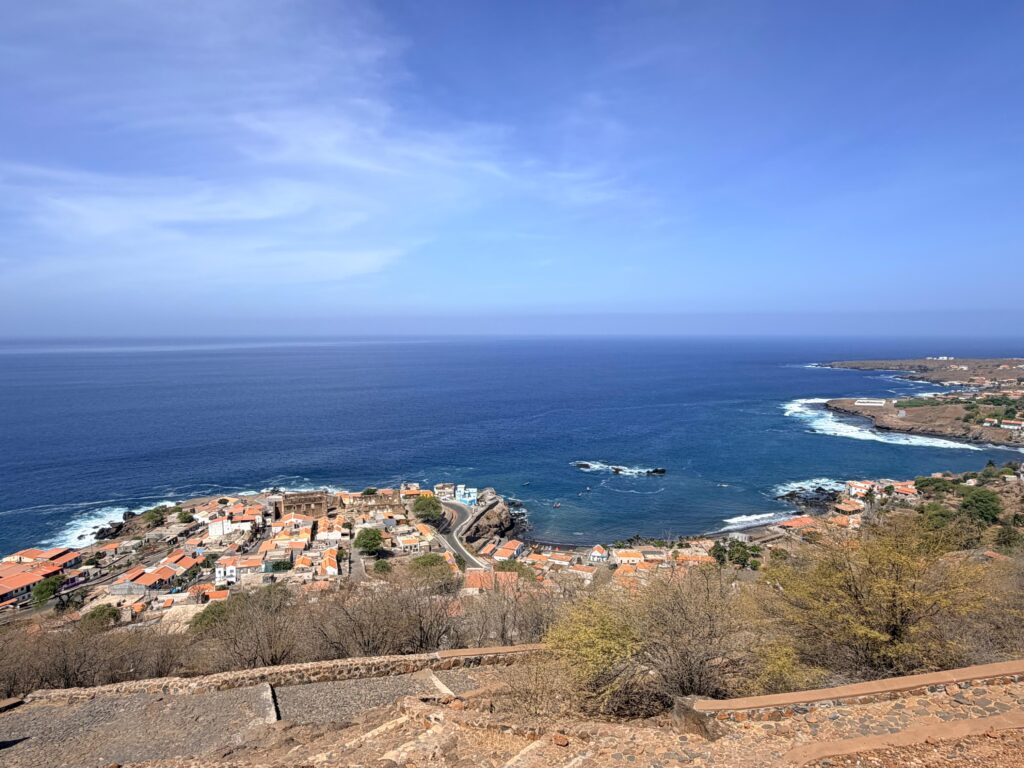
How Much of Your Week Should You Spend Travelling?
Seven days do not necessarily mean seven complete sightseeing days.
If Day 1 is the international arrival and Day 7 is the departure, only five days sit fully between them. An inter-island transfer in the middle of the trip then uses part of another day.
The scheduled flight or ferry time tells only part of that story.
Changing islands also involves leaving the accommodation, travelling to the airport or port, check-in and waiting time, the journey itself, arrival procedures, onward transport and settling into the next accommodation.
That does not make island-hopping a bad idea. It simply means transport has to be counted honestly.
| Trip structure | What it usually means in one week |
|---|---|
| 1 island | Very little inter-island logistics and a slower pace |
| 2 islands | Strong balance between variety and usable time |
| 3 islands | Possible, but two transfers take a visible share of the week |
| 4+ islands | Transport can begin to dominate a normal seven-day trip |
The connections matter as much as the number of islands.
São Vicente and Santo Antão, for example, are neighbouring islands linked by a short ferry connection. Combining them is logistically very different from moving between distant parts of the archipelago.
Seven Days or Seven Nights?
This distinction can materially change the trip.
Seven days / six nights usually means arriving on Day 1 and leaving on Day 7.
Seven nights / eight days moves departure to Day 8 and creates another full night within the itinerary.
That extra day is particularly valuable in an archipelago.
With Santiago + Sal, it can add more time in Santiago’s interior, allow Tarrafal to fit more comfortably, or create another relaxed day on Sal.
It also makes a three-island combination such as São Vicente + Santo Antão + Sal considerably easier to balance.
Our Cape Verde Essentials – 8 Days and Mountains to Beach – 8 Days use that additional time in two different ways.
Before following any “one-week Cape Verde itinerary”, check whether it actually describes seven days or seven nights.
Why Santiago + Sal Is a Strong First 7-Day Route
Santiago and Sal provide substantial variety while requiring only one planned inter-island transfer.
Santiago is Cape Verde’s largest island and home to Praia, the national capital. Urban life sits alongside agricultural areas, inland towns, mountain landscapes and some of the country’s most important historical sites.
Sal has a very different physical character. The island is flatter and drier, with volcanic terrain, salt pans, coastal communities and the resort town of Santa Maria.
Both islands have airports and are part of the domestic flight network.
The practical consequence is important: you can spend the first half of the week exploring and still leave the final days relatively open.
The route does not depend on visiting three or four islands to create contrast.
Day 1: Arrive in Santiago
Keep the first day flexible around your international flight.
After arriving at Nelson Mandela International Airport, transfer to your accommodation in Praia.
If the flight arrives with useful daylight remaining, the Plateau is a good place to begin. Praia’s historic centre contains public buildings, squares, markets, shops and streets that introduce the capital at an everyday pace.
Sucupira Market or the Municipal Market can also fit naturally into an early arrival.
A late flight requires very little planning beyond reaching the hotel and having dinner.
Nothing later in the itinerary depends on squeezing a full programme into the arrival day.
Day 2: Praia and Cidade Velha
The second day connects present-day Santiago with one of the most important historical sites in Cape Verde.
Spend part of the day in Praia before travelling south to Cidade Velha, the historic centre of Ribeira Grande.
Cidade Velha has been a UNESCO World Heritage Site since 2009. The settlement became the first permanent European colonial city established in the tropics and later played an important role in Atlantic trade, including the trafficking of enslaved Africans.
It was also one of the places where European and African populations, languages and traditions interacted during the early formation of Creole society.
That history gives Cidade Velha considerably more weight than a conventional old-town visit.
The surviving heritage includes the fortress, churches, the Pelourinho and the old street network, but understanding what happened here matters as much as seeing the surviving structures.
Allow enough time to explore without reducing the visit to a collection of photographs.
Return to Praia for the evening.
Day 3: Discover the Interior of Santiago
The third day moves inland.
Santiago changes significantly once you leave Praia. Agricultural areas, inland towns and mountain terrain gradually replace the urban and coastal setting of the previous days.
A practical route can combine São Jorge dos Órgãos or another agricultural area, Assomada and Serra Malagueta, depending on your interests and the way the day is organised.
Assomada provides a useful stop between the capital and the mountain regions.
Its market and surrounding agricultural activity show another side of everyday Santiago, while Serra Malagueta brings the journey into a much higher and more dramatic landscape.
The day can include viewpoints, a shorter walk or more time in the communities along the route.
Tarrafal is another worthwhile part of Santiago, but adding it automatically creates a considerably longer day.
With only seven days in Cape Verde, reaching the furthest possible point is less useful than giving enough time to the places already included.
Return to Praia for the final night on Santiago.
Day 4: Fly from Santiago to Sal
Day 4 is the main transfer day.
Domestic flight schedules can change, so confirm the Santiago–Sal connection for your dates before fixing all the surrounding accommodation.
The programme should remain deliberately light.
Check out in Praia, travel to the airport, fly to Sal and continue to Santa Maria.
What happens after that depends on the actual flight.
If several hours remain, walk through Santa Maria, spend some time at the beach or have a relaxed dinner after settling into the hotel.
If the connection uses most of the useful part of the day, the itinerary still works exactly as intended.
This day exists to move between islands. Any additional time in Santa Maria is useful, but the week does not depend on it.
Day 5: Explore Sal Beyond Santa Maria
Use one full day to discover Sal beyond the resort area.
The island is compact enough for a day of exploration to reveal several different landscapes and communities without requiring another change of accommodation.
A typical route can include Pedra de Lume, Espargos, Palmeira, Buracona, Terra Boa and Shark Bay, with the exact sequence determined by the excursion or driver.
Pedra de Lume
The salt pans of Pedra de Lume sit inside an extinct volcanic crater.
Commercial salt extraction began here in the early 19th century and played an important role in the island’s development.
Today, the site combines industrial history, volcanic geology and one of Sal’s most distinctive landscapes.
Espargos, Palmeira and Buracona
Espargos is the capital of Sal and provides some everyday context away from Santa Maria.
On the west coast, Palmeira remains an important fishing and port community and is a natural stop on the way to Buracona.
At Buracona, volcanic formations meet the Atlantic. The well-known Olho Azul effect depends on sunlight entering the formation at the right angle, so the visual effect varies with time and conditions.
Terra Boa and the North
Terra Boa adds an unexpected detail to an island usually associated with arid landscapes.
Parts of the area can retain water and support some agriculture, contrasting with the much drier terrain found across large sections of Sal.
Further east, the shallow waters around Shark Bay are known for lemon sharks.
The purpose of Day 5 is not to collect every named attraction.
It is to understand Sal as an island rather than spend the entire stay within the few kilometres around Santa Maria.
Day 6: Santa Maria at Your Own Pace
Protect one day from the itinerary.
After several structured days on Santiago, the inter-island transfer and a full exploration of Sal, Day 6 can remain flexible.
Santa Maria makes that easy.
You can spend the day on the beach, book a boat trip, go snorkelling or diving, try another water activity, walk through town or keep most of the day unplanned.
This flexibility also absorbs small changes elsewhere in the week.
If Day 4 leaves less time in Santa Maria than expected, nothing important has been lost.
If you discover an activity after arriving, there is somewhere to put it.
And if several hours beside the Atlantic are exactly what you want by this point in the trip, the itinerary already has room for them.
Day 7: Departure
Arrange the transfer to the airport around the international departure time.
Any remaining time in Santa Maria is optional. The itinerary does not rely on fitting another excursion into the final day.
By this point, the week has included three nights on Santiago, three nights on Sal and only one planned transfer between islands.
Alternative 7-Day Cape Verde Itineraries
Santiago + Sal is a practical general route for a first visit, but different priorities can lead to very different weeks.
| Main priority | Route to consider | Travel character |
|---|---|---|
| Culture + mountains + hiking | São Vicente + Santo Antão | Two neighbouring islands with a short ferry connection |
| Beach + simple logistics | Sal or Boa Vista | One main base and minimal inter-island travel |
| History + volcano | Santiago + Fogo | Strong cultural and volcanic focus; flight connection matters |
| Beach + culture + mountains | Sal + São Vicente + Santo Antão | High variety with a faster pace |
São Vicente + Santo Antão
This is one of the strongest one-week combinations for travellers who prefer culture, mountain scenery and hiking to a beach-focused finish.
São Vicente provides the airport gateway and Mindelo’s restaurants, music and urban life.
Santo Antão is reached by a short ferry connection from São Vicente and offers mountain roads, cultivated valleys, rural communities and some of the best hiking in Cape Verde.
Because the islands sit next to each other, the transfer carries a much smaller logistical penalty than many other two-island combinations.
A dedicated São Vicente + Santo Antão 7-Day Itinerary will develop this route in detail.
Sal or Boa Vista
A week on one island can be the right choice when the main priorities are beach time, water activities and a simple holiday.
Staying in one place removes domestic flights and inter-island ferries from the itinerary.
The result is more uninterrupted time for beaches, excursions and spontaneous days.
For some travellers, that is a much better use of seven days than trying to make the holiday feel larger by adding islands.
Santiago + Fogo
Santiago + Fogo suits travellers more interested in history, local culture and volcanic landscapes than in ending the week at a major beach destination.
A possible route combines Praia, Cidade Velha and part of Santiago’s interior with São Filipe and the volcanic landscapes around Chã das Caldeiras.
The domestic flight available on the actual travel dates should be checked before arranging the surrounding nights.
Our Fogo Travel Guide will make this combination easier to plan in more detail.
Can You Visit Three Cape Verde Islands in One Week?
Three islands can fit into seven days when the sequence is coherent and you are comfortable with a faster rhythm.
One example is:
Sal → São Vicente → Santo Antão
It combines beach, Mindelo and mountain landscapes within a single trip.
It also introduces a domestic flight, a ferry connection and more accommodation changes.
With seven days and six nights, those transfers occupy a noticeable part of the holiday.
With seven nights and eight days, the same idea becomes considerably easier to organise without reducing every island to a brief stop.
Our Mountains to Beach – 8 Days uses this second approach, combining São Vicente, Santo Antão and Sal with the additional day available.
The number of islands alone therefore says very little about whether an itinerary is comfortable. The sequence and the time spent moving between them matter just as much.
What Should You Book Before You Arrive?
A seven-day trip leaves relatively little room to repair a poor transport sequence after arrival.
Start with the elements that determine where you will sleep: international arrival and departure airports, the main domestic connection and the accommodation surrounding that transfer.
If Santo Antão is part of the route, check the ferry schedule before fixing the adjacent nights.
Activities that require a specific day or guide should also be confirmed early when they are central to the trip.
Local taxis, aluguers and many day activities can remain more flexible.
Our How to Get Around Cape Verde guide explains domestic flights, ferries, taxis, shared transport, private transfers and rental cars in more detail.
If You Have Seven Nights Instead
An eighth calendar day opens up noticeably more space.
For Santiago + Sal, it can extend the Santiago section, make Tarrafal easier to include, slow the inland journey down or add another free day on Sal.
Our Cape Verde Essentials – 8 Days follows this broader Santiago + Sal logic, with more time for the island’s interior, local communities and the transition to Sal.
Seven nights also make São Vicente + Santo Antão + Sal much easier to balance.
Our Mountains to Beach – 8 Days combines those three islands, using the extra time to accommodate both the domestic flight and the ferry without making the whole journey revolve around transfers.
The extra day therefore changes more than the number of activities you can add. It reduces the proportion of the trip consumed by logistics.
Planning Your 7-Day Cape Verde Trip
Santiago + Sal provides a varied first journey while keeping inter-island travel to one main transfer.
São Vicente + Santo Antão offers a more mountain-focused alternative with a short regional ferry connection.
A single-island stay protects even more of the week from transport.
Seven nights open the door to our more complete Cape Verde Essentials itinerary or the three-island Mountains to Beach journey.
Our local team can also build the route around your own dates and priorities, including domestic flights, ferries, airport and port transfers, accommodation, drivers, guides and activities.
The itinerary can then be adjusted to the international flights available, the experiences you want most and the amount of travel you are comfortable including within the week.