
Cape Verde uses the Cape Verdean escudo, written as CVE.
Cards make many payments easy, especially in hotels, larger restaurants, supermarkets and tourist centres. Cash still matters for taxis, markets, smaller businesses and travel away from the main towns.
Euros are also widely understood and often accepted in tourism areas, but there is an important detail: accepting euros does not necessarily mean using the official exchange rate.
For most travellers, a practical setup is simple: bring a working Visa or Mastercard, keep some Cape Verdean escudos for smaller payments, and carry a modest amount of euros as backup if that is convenient for you.
Quick Answer: How Should You Pay in Cape Verde?
| Situation | Practical payment option |
|---|---|
| Larger hotel or resort | Card usually works |
| Established restaurant | Card or CVE |
| Small restaurant or café | CVE is useful |
| Taxi | Cash is the safer assumption |
| Market or street stall | CVE |
| Tourist shop | Card, CVE and sometimes EUR |
| Rural area or small village | Carry cash |
| Excursion or local guide | Check beforehand |
| Remote excursion or hiking route | Carry cash for transport, food and stops away from main towns |
Payment habits vary between businesses, so treat these as planning guidance rather than rules.
What Currency Does Cape Verde Use?
The official currency is the Cape Verdean escudo, with the international currency code CVE.
You may also see prices written using the symbol $.
This can initially confuse travellers from countries that use dollars.
A price written as:
1.000$00
in Cape Verde means 1,000 Cape Verdean escudos, not US$1,000.
Hotels and tourism businesses sometimes display prices in euros as well, particularly in Sal and Boa Vista.
The escudo remains the official currency used throughout the country.
The Cape Verdean Escudo Is Fixed to the Euro
Cape Verde has a fixed exchange-rate arrangement with the euro.
The official rate is:
€1 = 110.265 CVE
This is not a floating EUR/CVE rate that changes every morning.
For practical mental arithmetic, travellers often round it to around:
€1 ≈ 110 CVE
So:
- 1,100 CVE is roughly €10;
- 5,500 CVE is roughly €50;
- 11,000 CVE is roughly €100.
The exact peg becomes particularly useful when somebody offers to accept euros directly.
Can You Use Euros in Cape Verde?
Yes, in many places.
Euros are particularly common in areas with a large international tourism industry. Hotels, restaurants, excursion providers and shops in places such as Santa Maria on Sal or the principal tourism areas of Boa Vista may quote prices in euros or accept euro banknotes.
A small restaurant, taxi driver, market seller or village shop may still expect payment in escudos.
Even when euros are accepted, check the conversion being used.
The €1 = 100 CVE Shortcut
Some businesses use an informal conversion of:
€1 = 100 CVE
It is easy to calculate.
It is also less favourable to the traveller than the official rate of 110.265 CVE.
Suppose something costs:
2,000 CVE
At the official fixed rate, that is approximately:
€18.14
If a business converts at 100 CVE to the euro, the same purchase becomes:
€20
For one small purchase, the difference may feel unimportant.
Across meals, excursions, transfers and other spending, repeated conversions can add up.
This does not mean you should refuse every euro price or negotiate over a few cents. It simply helps to understand which rate is being used.
Is It Better to Pay in Euros or Escudos?
If a price is quoted in CVE, paying in CVE normally keeps the transaction straightforward.
If a hotel, tour or restaurant has genuinely priced a service in euros, paying in euros may be equally convenient.
The main thing is to avoid an accidental conversion that makes the purchase considerably more expensive.
For example, if something costs 3,000 CVE and the merchant accepts €30 using the convenient 100:1 conversion, you have paid more than the official peg would imply.
On the other hand, repeatedly withdrawing small amounts of cash can also create bank and ATM fees.
You do not need to optimise every transaction to the last cent. Understanding the main conversion costs is enough to avoid repeatedly choosing a more expensive option without noticing.
Cash or Card in Cape Verde?
Cape Verde has a modern electronic payment network, but visitors should still carry cash.
That combination works well because different parts of the trip create different payment needs.
You may pay a hotel bill by card in the morning, take a taxi in cash at lunchtime and buy something from a small shop later using escudos.
On another island, you might spend most of the day without using a card at all.
Card Is Often Convenient For
Cards are commonly useful at:
- hotels and resorts;
- larger restaurants;
- supermarkets;
- established tourism businesses;
- larger shops;
- some excursion operators.
Visa and Mastercard are the most useful international networks to bring.
Cash Becomes More Useful For
Carry cash for situations such as:
- taxis;
- aluguers;
- markets;
- small cafés;
- small local restaurants;
- village shops;
- roadside purchases;
- some guides and activities;
- rural or remote areas.
There can also be temporary situations where a card terminal is unavailable, connectivity fails or a business simply prefers cash.
Keeping a second payment option avoids unnecessary problems when that happens.
Which Cards Work in Cape Verde?
The Cape Verdean payment network supports international card transactions.
For most visitors, Visa and Mastercard are the safest choices.
Debit and credit cards using these networks can be accepted at participating businesses and compatible ATMs.
American Express is also supported by parts of the payment network, but acceptance depends on the merchant’s contract. It should not be your only card.
Whatever the logo on the card, acceptance still depends on the individual merchant.
A restaurant having a card terminal does not guarantee that every international card will work every time.
For a longer trip, carrying two cards can be sensible, particularly if they are issued by different providers.
Keep them separately. There is little benefit in having two backup cards if both disappear with the same wallet.
Can You Use Revolut or Wise in Cape Verde?
A Revolut, Wise or similar card may work wherever its underlying Visa or Mastercard network is accepted, subject to the provider’s own country, withdrawal and usage rules.
The usual considerations still apply:
- your card must support overseas transactions;
- the terminal or ATM must accept its network;
- your provider may apply withdrawal or usage limits;
- ATM or currency-conversion charges can still apply.
Check the current conditions of your own account before travelling.
A low-fee international card can be useful, but it does not remove the need for some cash.
ATMs in Cape Verde
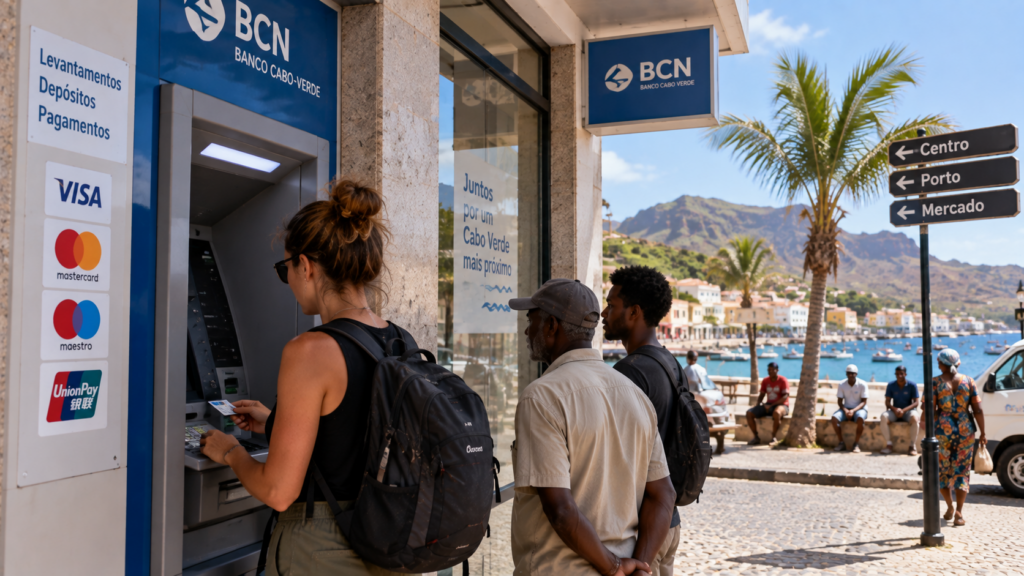
Cape Verde’s national electronic payments network is known as Vinti4.
ATMs are available across the islands and in the main urban and tourism centres.
International visitors can normally use compatible foreign cards to withdraw Cape Verdean escudos.
Access becomes less convenient in smaller settlements and on routes away from the main towns.
ATM Withdrawal Limits and Fees
ATMs can impose limits on the amount withdrawn in one transaction.
They may also apply a local withdrawal fee.
Your own bank or card provider can add another charge.
That creates three possible costs:
- the local ATM fee;
- your bank’s cash-withdrawal fee;
- currency conversion charges.
Limits and charges can change, so check what the ATM displays before confirming the transaction.
Recent travellers often report particular Vinti4 withdrawal limits and fixed local fees, but these should be treated as operational information rather than permanent national rules.
Plan your withdrawals before cash becomes urgent, particularly when you are about to leave a main town.
What Currency Do Cape Verde ATMs Dispense?
For normal local withdrawals, expect Cape Verdean escudos.
Do not assume an ATM will give you euros simply because the escudo is fixed to the euro or because euros are widely used in tourism.
If you specifically need euro cash, use an appropriate banking or exchange service rather than treating local ATMs as euro dispensers.
Watch for Dynamic Currency Conversion
When using a foreign card, an ATM or payment terminal may sometimes offer to convert the transaction into your home currency.
For example, a European traveller may see a choice between:
- CVE
- EUR
This can involve Dynamic Currency Conversion, usually abbreviated to DCC.
With DCC, the ATM or merchant-side payment provider performs the conversion and shows the amount in your home currency.
That may feel reassuring because the amount is immediately familiar.
It can also involve a less favourable conversion rate.
If you decline the home-currency conversion and continue in CVE, the conversion will normally be handled according to the terms of your card issuer or payment provider.
Check the rate and fees offered before accepting a home-currency conversion.
The fixed EUR/CVE peg does not guarantee that a commercial DCC rate will reproduce the official 110.265 conversion.
Payment Habits Change During the Trip
The amount of cash you need depends partly on where you go.
In Resort and Tourism Centres
Sal and Boa Vista have highly developed international tourism.
Cards and euro payments are therefore more common around:
- resorts;
- larger hotels;
- restaurants;
- excursion companies;
- tourism-oriented shops.
Cash is still useful outside the most tourism-focused businesses.
In Praia and Mindelo
Praia and Mindelo have a broader range of banking, shopping and restaurant infrastructure.
Cards can be used for many ordinary purchases, while markets, taxis and smaller businesses may still be easier with cash.
In Smaller Towns, Villages and Rural Areas
As you move away from the larger centres, cash becomes more useful.
Electronic payments are still available in some smaller towns and businesses, but acceptance becomes less predictable.
Money Planning for Santo Antão and Other Remote Travel
This becomes particularly relevant during island hopping.
Suppose you are leaving Mindelo for several days on Santo Antão.
ATMs are available on Santo Antão, but their existence does not make them convenient for every hiking route or village stay.
Your accommodation may accept card while:
- the driver does not;
- lunch in a village is cash-only;
- a small shop has no working terminal;
- an ATM is inconveniently located for your route.
Before travelling away from a main centre, carry enough CVE to cover ordinary small expenses for the next part of the itinerary.
The appropriate amount depends heavily on what has already been prepaid.
Should You Bring Euros From Home?
For travellers coming from the eurozone, bringing some euro cash can be a useful backup.
There is usually little practical reason to carry the entire holiday budget in banknotes.
A combination works better:
- card for larger purchases;
- CVE for everyday cash expenses;
- some euros as reserve.
Euros have a particular advantage over pounds or US dollars in Cape Verde because the escudo is directly fixed to the euro.
That makes the relationship between the two currencies transparent.
Can You Use British Pounds in Cape Verde?
Do not rely on British pounds for everyday payments.
GBP can be exchanged through appropriate banking or foreign-exchange services, but the GBP/CVE rate is not fixed.
It changes as sterling moves against the euro.
A British traveller will usually find it easier to use an international card, withdraw CVE or carry some euros as backup rather than trying to pay directly in pounds.
Can You Use US Dollars in Cape Verde?
Do not rely on US dollars for everyday payments.
Unlike the euro, the dollar has no fixed relationship with the Cape Verdean escudo.
USD should normally be exchanged through an appropriate service or converted through your bank or card provider.
For an American traveller, a suitable international card plus local CVE is generally the more practical combination.
Should You Exchange Money Before Travelling?
For most European visitors, there is little practical reason to obtain a large amount of CVE before travelling.
Euros can be exchanged locally, and compatible international cards can be used at Vinti4 ATMs.
What makes sense depends on your bank’s fees and the places you are visiting.
A traveller spending a week around a major resort has different cash requirements from someone travelling through Santo Antão, Santiago and Fogo.
Where Can You Exchange Money?
Banks and authorised foreign-exchange services can exchange major currencies into CVE.
Exchange facilities may also be available at airports, hotels and other authorised locations.
Hotels and tourism businesses may sometimes accept euros directly instead of formally exchanging them.
The rate matters.
Because the EUR/CVE peg is fixed, a euro traveller has a particularly useful reference:
€1 = 110.265 CVE
If you are offered a substantially different commercial conversion, you can see the cost of the convenience immediately.
For pounds, dollars and other currencies, check the current Banco de Cabo Verde reference rates because they change.
How Much Cash Should You Carry?
There is no useful single amount for every traveller.
Think instead about the next part of the trip.
If you are staying in Santa Maria with cards, ATMs and a hotel nearby, you may need relatively little cash.
If tomorrow involves:
- an aluguer;
- a remote hike;
- lunch in a village;
- a local driver;
- a ferry;
- a smaller island;
your cash reserve deserves more attention.
Carry enough to cover likely small expenses and transport until you next expect reliable access to an ATM.
There is no need to carry the entire holiday budget simply because cash may be useful later.
What About Taxis?
Cash remains the safer assumption for taxis.
In tourism areas, drivers may accept euros as well as CVE.
Before starting the journey, clarify:
- the fare;
- the currency;
- whether the amount quoted is per journey or per person where relevant.
If paying in euros, understanding the conversion being used prevents a simple fare from becoming unnecessarily confusing.
Taxis, aluguers and local transport belong in more detail in our guide to getting around Cape Verde.
What About Restaurants?
Larger restaurants, particularly in tourist centres and major cities, often accept international cards.
Small restaurants may prefer cash.
If you are depending entirely on a card, check before ordering.
This becomes more useful away from the main tourism and urban centres.
If you already have CVE with you, the issue often disappears.
What About Tips?
Tipping is separate from the question of currency and payment infrastructure.
Where you choose to tip, cash is often the easiest option.
The broader question of local tipping customs belongs in its own practical guide.
What About Leftover Cape Verdean Escudos?
Avoid withdrawing much more CVE than you expect to spend near the end of the trip.
If you have a significant amount left, ask an authorised bank or exchange service about current conversion options before departure.
There is also a specific rule for taking Cape Verdean currency out of the country.
Current Banco de Cabo Verde guidance allows travellers to take up to 20,000 CVE in national currency per person, per trip without prior authorisation.
Taking a larger amount of CVE out of Cape Verde requires prior authorisation from the Banco de Cabo Verde.
This rule concerns Cape Verdean national currency and should not be confused with the separate rules governing the movement or declaration of foreign currency.
A Practical Money Setup for Cape Verde
You do not need a complicated financial system for the trip.
Before departure:
- bring at least one Visa or Mastercard;
- consider a second card stored separately;
- check your provider’s foreign ATM and card fees;
- know or verify your PIN;
- carry some euro cash as backup if convenient.
After arrival:
- obtain a reasonable amount of CVE;
- use card where it works conveniently;
- keep cash for small purchases, taxis and informal businesses;
- pay attention to the currency offered by card terminals and ATMs.
Before travelling to a smaller island or remote area:
- think through the next day’s likely cash expenses;
- withdraw before leaving a well-served town if necessary;
- ask your accommodation, guide or agent about payments required during the next part of the trip.
The aim is simply to avoid reaching a point where the only payment method you have is the one a particular business cannot accept.
Where Local Advice Helps
Money questions become more specific once an itinerary moves beyond hotels and resorts.
A travel agent or local guide may know that tomorrow’s transfer needs cash, that lunch on a particular excursion is paid locally or that withdrawing money before leaving town will make the day easier.
They can also tell you when card acceptance is normal for a particular activity instead of leaving you to infer it from general travel advice.
This does not replace your bank’s information about fees or normal financial precautions.
It makes payment planning fit the trip you are actually taking.
Check the Official Exchange Rate
For the official Cape Verdean exchange rate and current reference rates for other currencies, use the Banco de Cabo Verde.
The EUR/CVE peg is fixed at:
€1 = 110.265 CVE
Rates against currencies such as GBP and USD vary and should be checked close to travel.
Planning Your Cape Verde Trip?
If your itinerary includes several islands, remote excursions or smaller towns, practical details such as cash availability can be worth checking before each stage of the journey.
Frequently Asked Questions
What currency is used in Cape Verde?
Cape Verde uses the Cape Verdean escudo, currency code CVE.
The escudo is fixed to the euro at €1 = 110.265 CVE.
Can you use euros in Cape Verde?
Yes, euros are accepted by many tourism businesses, particularly in Sal and Boa Vista.
They are not accepted everywhere, and individual businesses may use a different conversion from the official EUR/CVE peg.
Is it better to use euros or escudos in Cape Verde?
If a price is given in escudos, paying in CVE is usually straightforward.
Euros can be convenient where businesses quote prices in euros or clearly accept them.
Check the conversion being used rather than assuming every euro payment follows the official rate.
Are credit and debit cards accepted in Cape Verde?
Yes.
Visa and Mastercard are accepted by many hotels, restaurants, supermarkets and established businesses.
Card acceptance becomes less predictable in small businesses, markets, taxis and rural areas.
Are there ATMs in Cape Verde?
Yes.
Vinti4 ATMs are available across the islands and in the main urban and tourism centres.
Access may be less convenient in smaller settlements, so it is sensible to withdraw cash before remote travel when necessary.
Can I use Revolut or Wise in Cape Verde?
A Revolut, Wise or similar card may work wherever its underlying Visa or Mastercard network is accepted.
The provider’s own foreign-use, conversion and ATM rules still apply.
Can I use US dollars in Cape Verde?
Do not rely on US dollars for everyday payments.
The Cape Verdean escudo is fixed to the euro rather than the dollar. An international card or local CVE is generally more practical.
Can I use British pounds in Cape Verde?
British pounds are not normally used for everyday payments.
They can be exchanged through appropriate banking or foreign-exchange services, while cards, CVE and euro cash are generally more practical for British visitors.
How much cash should I take to Cape Verde?
There is no fixed amount.
Carry enough to cover small purchases, local transport and the next part of the itinerary, particularly when leaving a major town or travelling into rural areas.
Should I choose euros or CVE at an ATM or card terminal?
If you are offered a home-currency conversion, check the exchange rate and fees before accepting.
Declining that conversion and continuing in CVE normally leaves the currency conversion subject to your card issuer or payment provider’s terms.