Diving in Cape Verde combines volcanic underwater landscapes, Atlantic marine life, wrecks, walls, caverns and year-round scuba diving.
The islands offer distinct diving experiences, so choosing the right base is an important part of planning the trip.
Sal is the most straightforward option for many first-time visitors, with several established dive centres around Santa Maria and a wide range of sites. Boa Vista combines diving with a beach-focused stay. São Vicente fits naturally into trips that also include Mindelo and Santo Antão. Santiago offers a smaller diving scene alongside culture, history and island exploration.
The choice also affects transport.
A traveller spending several nights on Sal can organise repeated dive days from the same base. Someone combining São Vicente, Santo Antão, Santiago or Fogo also needs to consider ferries, domestic flights and post-dive surface intervals.
For multi-island trips, diving and transport should be planned together.
Diving in Cape Verde at a Glance
Diving season: year-round
Broadly favourable period: April to November
Typical water temperature: approximately 20–28°C depending on island and season
Visibility: commonly around 15–30+ m, sometimes better
Most straightforward diving base: Sal
Other established options: Boa Vista, São Vicente and Santiago
Dive types: reefs, volcanic walls, caverns, swim-throughs, wrecks, drift dives and shallow training sites
Marine life: turtles, rays, moray eels, barracuda, tuna, groupers, octopus, nudibranchs and several shark species
Beginners: introductory dives and certification courses available on the main diving islands
Experienced divers: deeper wrecks, walls, currents, offshore reefs and cavern environments
Important for island-hopping: leave enough surface time before flying or travelling to significantly higher altitude
What Diving in Cape Verde Is Like
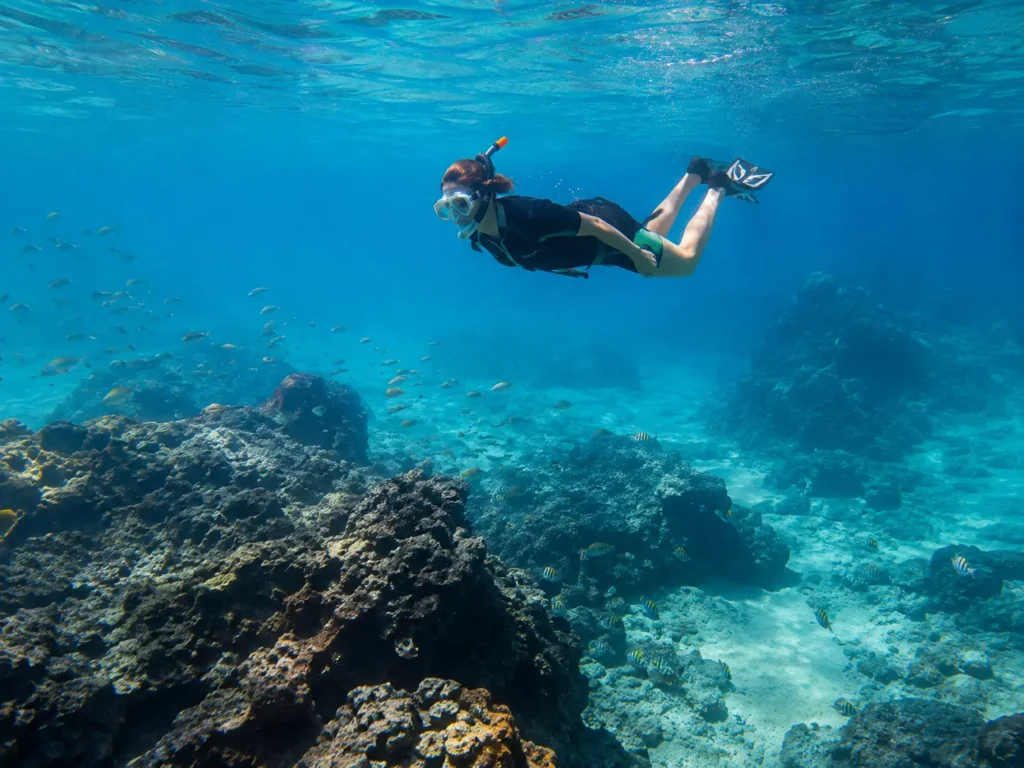
Cape Verde lies in the Atlantic Ocean off West Africa, where tropical influence meets open-ocean conditions.
Underwater, this creates a mixture of volcanic rock, sandy areas, reef communities, wrecks and open-water sites rather than one uniform diving environment across the archipelago.
Depending on the island and site, dives may include:
- volcanic walls and rock formations;
- caverns and swim-throughs;
- wrecks;
- shallow reefs;
- sandy areas with rays;
- deeper offshore reefs;
- stronger-current dives;
- night diving.
The same island can offer very different levels of difficulty.
On Sal, for example, a relatively shallow wreck can be available in the same destination as deeper wrecks, exposed offshore sites and volcanic cavern systems.
Certification level, recent experience and current sea conditions are therefore more useful planning factors than simply choosing from a list of famous dive sites.
Choosing the Right Island for Diving
The best diving island depends on how important scuba is to the wider trip.
Sal — The Most Straightforward Diving Base
Sal has one of the most established recreational diving scenes in Cape Verde.
Most centres operate from Santa Maria, while some trips also use locations around Palmeira and the west coast.
The island offers a broad mixture of:
- shallow sites;
- volcanic reefs;
- walls;
- wrecks;
- caverns and swim-throughs;
- deeper offshore dives;
- introductory experiences;
- certification courses.
This makes Sal practical for groups with mixed experience levels.
A beginner can complete an introductory dive or course while a more experienced diver uses other days for deeper wrecks, walls or more exposed sites.
For the rest of the island, see our Sal Travel Guide, Things to Do in Sal and Where to Stay in Sal.
Dive Sites on Sal
Rather than ranking sites, it is more useful to understand what type of diving each one offers.
Santo Antão Wreck
Despite the name, the Santo Antão wreck is off Sal, not off the island of Santo Antão.
The wreck lies in roughly 12 metres of water and has broken into several sections.
Its shallow depth makes it one of the more accessible wreck experiences around Sal for certified divers, depending on local conditions and the dive centre’s requirements.
The name can easily confuse travellers planning several islands.
When booking, check the island as well as the name of the dive site.
Kwarcit / Boris Wreck
Kwarcit and Boris are two names used for the same wreck.
The wreck lies at around 28 metres, making it a significantly deeper dive than the Santo Antão wreck.
Certification, recent experience, gas planning and the dive centre’s own requirements become much more important at this depth.
It is a good example of why two wreck dives on the same island can require very different levels of preparation.
Three Caves
Three Caves combines underwater volcanic formations with caverns and swim-throughs.
It gives a strong sense of Sal’s volcanic geology beneath the surface.
Some dive sites around Cape Verde include cavern sections or swim-throughs. Any route that creates a true overhead environment should match the diver’s training and the dive centre’s requirements.
The site name alone does not tell you whether a particular route is suitable for your certification or recent experience.
Buracona and Regona
The west coast includes volcanic formations, tunnels and cavern areas around Buracona and Regona.
These sites can be more dependent on sea conditions than sheltered southern locations.
Wind and swell may make one side of the island unsuitable while another site remains perfectly diveable.
A good operator adapts the day’s site to the sea rather than following a rigid weekly schedule.
Tchoclassa
Tchoclassa is an offshore reef with deeper sections and a stronger open-water character.
It shows another side of diving on Sal beyond shallow training sites and resort-based experiences.
Experienced divers can encounter more demanding conditions once dives move into deeper and more exposed Atlantic water.
Shark Bay Is a Wildlife Excursion
Shark Bay is widely promoted on Sal because juvenile lemon sharks enter very shallow water close to shore.
For most visitors, this is a wading or shallow wildlife experience, rather than a scuba dive.
It can be a useful activity for non-divers travelling with divers, or for anyone interested in seeing sharks from close range in shallow water.
A traveller choosing a full scuba day should count wreck, reef or wall dives separately.
Boa Vista — Diving with a Beach Stay
Boa Vista is a practical choice for travellers already planning a beach-focused holiday.
Dive operations are concentrated mainly around Sal Rei and the larger resort areas.
Published programmes include reefs, wrecks and sites where turtles, rays, sharks and schooling fish may be encountered.
Boa Vista has fewer operators than Sal, so travellers who consider diving a priority should confirm availability, equipment, course dates and planned sites before arrival.
For someone already choosing Boa Vista for beaches and relaxation, adding several dives can work very well without turning the entire trip into a dedicated diving holiday.
São Vicente — Diving from Mindelo
São Vicente places diving in a very different travel setting.
You can stay in Mindelo, dive around the island and combine the same trip with music, restaurants, cultural sites, an island tour and onward travel to Santo Antão.
Current dive operations around São Vicente offer wrecks, drop-offs, caverns, night diving and volcanic underwater terrain.
Published sites include areas such as Fateixa, Djeu and Ponta da Doca, along with wreck diving around Mindelo.
For travellers already planning São Vicente + Santo Antão, one or two dive days in São Vicente can fit naturally into the itinerary.
The timing of the final dive becomes important before continuing by ferry and then travelling into the mountains of Santo Antão.
See our São Vicente Travel Guide, Mindelo Travel Guide and Things to Do in São Vicente Beyond Mindelo.
Santiago — Diving alongside Culture and History
Santiago also has an active diving scene.
Current operations are available around Cidade Velha, while diving has also been offered around other parts of the island, including the north.
Underwater experiences can include volcanic terrain, schooling fish, moray eels, octopus, rays and occasional larger marine life.
Santiago works best for travellers who already want to explore Praia, Cidade Velha, mountains, local markets and the island’s history.
Diving can then be added as one part of a broader stay.
For the rest of the island, see Things to Do in Santiago.
Can Beginners Dive in Cape Verde?
Yes.
The main diving islands have operators offering introductory experiences for people without certification, along with entry-level courses.
Sal is particularly convenient because several centres operate from the same resort area and relatively sheltered sites are available for training.
A first dive should be selected according to conditions, supervision and depth.
Deep wrecks, stronger-current sites and overhead cavern environments belong to a different category from an introductory experience.
Certified divers returning after a long break should tell the centre when booking.
A refresher or skills review can make the first day much more comfortable and allow later dives to focus on the site rather than basic equipment and buoyancy skills.
Diving for Experienced Divers
Experienced divers can find much more than shallow resort diving.
Depending on the island and conditions, Cape Verde offers:
- deeper wrecks;
- walls;
- drop-offs;
- drift dives;
- stronger currents;
- offshore reefs;
- volcanic caverns and swim-throughs;
- night dives.
Certification, recent experience and the exact route determine whether a particular wreck, cavern or current is appropriate.
Ask the dive centre about:
- maximum depth;
- expected current;
- overhead sections;
- entry and exit;
- visibility;
- expected bottom time;
- specific certification requirements;
- recent experience requirements.
This gives a much clearer picture than the site name alone.
Water Temperature in Cape Verde
Water temperatures vary through the year and slightly between islands.
A practical planning range is approximately 20–28°C.
On Sal, operators commonly report cooler winter water around 21–22°C, with temperatures rising towards approximately 26–28°C during warmer months.
That difference becomes important during repeated dives.
A diver comfortable in a thin wetsuit in late summer may want considerably more thermal protection during winter.
Local centres normally select or recommend suits according to season.
If you tend to get cold underwater, mention it when booking rather than relying only on an average temperature chart.
Visibility and Atlantic Conditions
Cape Verde often has good underwater visibility.
A practical expectation is around 15–30 metres or more, with better visibility possible on some days and sites.
Visibility changes with:
- wind;
- swell;
- current;
- tide;
- location;
- recent weather.
The windier part of the year can make exposed locations uncomfortable or inaccessible while a protected site elsewhere remains suitable.
For this reason, it is better to plan several possible dive days than to build the entire trip around one particular site on one fixed date.
Best Time to Dive in Cape Verde
Scuba diving is available throughout the year.
For a broad combination of warmer water and generally favourable conditions, April to November is a useful planning window.
Later summer and autumn tend to bring warmer water.
Winter months can bring stronger trade winds and more surface movement, particularly at exposed sites.
Diving continues from December to March, but site selection can depend more heavily on the conditions of the day.
Travellers whose main priority is scuba should allow enough days for an operator to choose the best available sites rather than expecting a fixed programme regardless of the sea.
Marine Life You May Encounter
Cape Verde’s marine life includes reef species, open-water fish and larger animals.
Depending on site and season, divers may encounter:
- loggerhead and green turtles;
- stingrays;
- eagle rays;
- nurse sharks;
- moray eels;
- barracuda;
- tuna;
- jacks;
- groupers;
- trumpetfish;
- pufferfish;
- octopus;
- cuttlefish;
- nudibranchs;
- lobsters;
- large schools of fish.
Marine-life encounters vary from dive to dive.
A good diving day can still be excellent without one specific shark, turtle or ray appearing.
Humpback Whales and Diving
Humpback whales visit Cape Verde waters seasonally.
Sightings from dive boats can occur during the appropriate period, and divers may occasionally hear whale song underwater.
Direct underwater encounters are exceptional.
Travellers interested specifically in whales should plan a dedicated wildlife experience rather than depend on a normal dive.
See our Whale Watching in Cape Verde guide for season, islands and planning.
Turtles and Diving
Sea turtles are regularly encountered underwater around several Cape Verde islands.
Nesting on beaches is a separate seasonal wildlife experience, particularly important on islands such as Boa Vista and Sal.
Responsible nesting excursions follow conservation rules designed to reduce disturbance.
See Turtle Watching in Cape Verde for the land-based experience and the best time to plan it.
How Much Does Diving in Cape Verde Cost?
Prices vary by island, dive centre, equipment rental, number of dives and certification level.
As a 2026 reference, published prices we found on Sal range from roughly €39 to €52 for a single certified dive, depending on the operator and what is included.
Multi-dive packages normally reduce the cost per dive.
Introductory dives, courses, specialist sites and equipment rental can change the final price considerably.
When comparing operators, ask whether the quoted price includes:
- tanks and weights;
- BCD and regulator;
- wetsuit;
- dive computer;
- boat transport;
- guide or instructor;
- insurance;
- specialist-site supplements;
- certification fees for courses.
Two prices can look very different simply because one includes equipment and the other does not.
Choosing a Dive Centre
Certification agency is only one factor.
A good centre should ask about your experience before assigning a site.
Useful points to check include:
- clear briefings;
- well-maintained equipment;
- sensible group sizes;
- transparent depth and certification requirements;
- willingness to change the dive when sea conditions deteriorate;
- oxygen and emergency procedures;
- suitable boat safety equipment;
- insurance information.
Tell the centre:
- your certification level;
- number of logged dives;
- date of your most recent dive;
- experience with currents, wrecks or overhead environments;
- any long break from diving.
This helps the operator choose a dive that fits the diver rather than simply filling a boat.
Diving and Domestic Flights
This is one of the most important practical details for a multi-island Cape Verde itinerary.
Your final dive and your next flight need enough separation.
Divers Alert Network recommends at least:
12 hours before flying after a single no-decompression dive
and:
18 hours after multiple dives in the same day or multiple days of diving
Longer intervals provide additional conservatism.
After dives requiring mandatory decompression stops, longer intervals are appropriate.
This matters in Cape Verde because domestic flights are often part of the connection between islands.
A plan such as:
morning dives on Sal → afternoon flight to São Vicente
may therefore be unsuitable even when the flight timetable appears convenient.
A better sequence is:
diving days → final surface interval → onward flight
The final day on the island can be used for beaches, sightseeing, food, shopping or another land activity.
See Domestic Flights in Cape Verde when planning inter-island connections.
Post-Dive Ferries and Mountain Roads
A ferry journey near sea level does not create the same reduced-pressure exposure as flying.
The journey after the ferry can still matter.
A practical Cape Verde example is:
diving in São Vicente → ferry to Porto Novo → road journey into the mountains of Santo Antão
The ferry remains close to sea level, but roads into the interior of Santo Antão climb rapidly.
The area around Cova reaches roughly 1,170 metres, while higher sections of the surrounding Cova–Paul–Ribeira da Torre landscape exceed 1,500 metres.
DAN notes that travelling to significantly higher altitude after diving, including by road, increases decompression stress.
If your post-dive plan includes a mountain transfer, discuss the timing with your dive centre and follow the guidance of your dive computer and appropriate diving procedures.
When planning island-hopping, check both:
- the time before the next flight;
- the altitude reached during the journey that follows the final dive.
For ferry planning, see Cape Verde Ferries.
Planning Your Number of Dive Days
For someone trying scuba for the first time, one introductory day may be enough.
A certified diver who wants to experience more than one type of site should consider at least two dive days.
That provides some flexibility if wind or swell changes the plan and allows the operator to choose contrasting sites.
When scuba is one of the main objectives of the trip, three to five diving days make Sal particularly easy to justify as a longer base.
The final dive also affects onward travel.
In practice, the required surface interval can add another useful night on the island.
Matching the Island to the Trip
Sal is the easiest fit when scuba is one of the main reasons for travelling and you want a broad choice of centres and dive types.
Boa Vista suits a beach-focused trip where diving is one of several activities.
São Vicente works well when scuba is being combined with Mindelo and Santo Antão.
Santiago suits a broader journey based around culture, history and exploring the island, with diving added to the itinerary.
For multi-island trips, transport time and post-dive timing can matter more than adding another dive site to the list.
Each additional island means another airport, port, hotel transfer and potential timetable constraint.
Diving in a 7-Day Cape Verde Trip
With seven days, use one main diving island.
Several nights on Sal, for example, allow a mixture of dive days and land activities without turning the trip into a sequence of transfers.
If São Vicente is the base, diving can be combined with Mindelo and followed by Santo Antão once the post-dive timing has been planned correctly.
See our Cape Verde 7-Day Itinerary for the wider travel structure.
Diving in a 10-Day Cape Verde Trip
Ten days give enough room for a two-island itinerary with diving built into one of the bases.
The order matters.
If the second island requires a flight, place the final dive early enough to respect the pre-flight surface interval.
If the onward journey involves a ferry followed by mountain roads, consider the altitude reached after the crossing.
See our Cape Verde 10-Day Itinerary for broader planning.
Diving in a 14-Day Cape Verde Trip
Two weeks provide much more flexibility.
A diver can use one island as the main scuba base and still include other parts of Cape Verde without turning every few days into a travel day.
Sal can provide several days of diving before continuing elsewhere.
São Vicente can combine scuba with Mindelo before the trip moves towards Santo Antão.
The number of islands should still reflect the complete transport blocks rather than only the nominal flight or ferry duration.
See our Cape Verde 14-Day Itinerary.
Diving in Mixed Groups
Mixed groups are relatively easy to accommodate on several islands.
Sal and Boa Vista offer beaches, island tours, snorkelling and other activities while one person dives.
São Vicente adds Mindelo, food, music and island exploration.
Santiago adds Praia, Cidade Velha, markets, mountains and cultural sites.
For couples or families where only one person dives, the best island may be the one that gives everyone else the strongest day while the diver is underwater.
Plan Your Diving Trip to Cape Verde
Start with the type of trip you want and then fit the diving around it.
Tell us:
- your travel dates;
- certification level;
- number of logged dives;
- date of your most recent dive;
- whether you want introductory, recreational or more advanced diving;
- preferred number of dive days;
- islands you are considering;
- whether anyone in the group does not dive;
- whether you also want beaches, hiking, culture or wildlife;
- planned domestic flights;
- planned ferries and mountain transfers.
We can help combine islands, accommodation, transfers, diving days and onward travel so that scuba fits naturally into the wider itinerary.
Plan My Cape Verde Diving Trip