
SEO
A trip to Fogo changes considerably depending on whether you sleep in São Filipe, inside Chã das Caldeiras, or divide your stay between the two.
Pico do Fogo shapes much of the island’s geography, but a Fogo itinerary also needs to account for São Filipe, Chã das Caldeiras, the greener northern slopes and the time required to move between them.
The island is compact enough to explore in a few days, yet the journey from the coast into the high volcanic interior takes time. Trying to see São Filipe, visit Chã das Caldeiras, climb the volcano and explore the north in one or two rushed days leaves very little room for anything beyond the main stops.
For many first visits, three days is a useful minimum. Four or five give considerably more flexibility, particularly if hiking is an important part of the trip.
Fogo at a Glance
| Best for | Volcanic landscapes, hiking, local food and wine, history |
| Main town | São Filipe |
| Main natural area | Parque Natural do Fogo |
| Highest point | Pico do Fogo, 2,829 m |
| Main mountain base | Chã das Caldeiras |
| Good first stay | 3 days |
| More complete stay | 4–5 days |
| Airport | São Filipe, domestic flights only |
| Good combination | Santiago; Brava if ferry logistics fit |
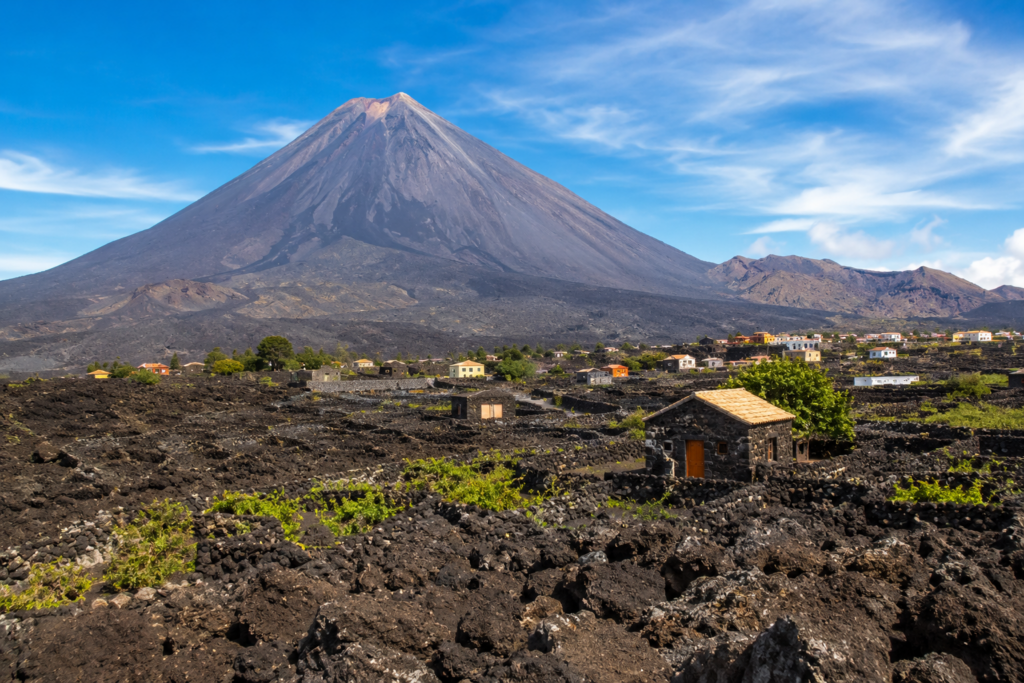
Pico do Fogo rises to 2,829 metres, making it the highest point in Cape Verde.
The volcano sits within the Parque Natural do Fogo, an area of around 8,468.5 hectares that includes Pico do Fogo, the crater, the Bordeira escarpment and the Monte Velha forest perimeter.
The caldera is about eight kilometres across, with Chã das Caldeiras occupying the high interior below the volcanic cone.
Fogo remains volcanically active. Its most recent eruption began on 23 November 2014, reshaping parts of Chã das Caldeiras and creating lava formations that are now part of the landscape crossed by residents and visitors.
How Many Days Do You Need in Fogo?
Two Days
Two days are possible, but priorities need to be clear.
One day can cover São Filipe and a visit to Chã das Caldeiras. If climbing Pico do Fogo is the main reason for travelling to the island, the ascent will occupy much of another day.
That leaves little room for Mosteiros, Monte Velha, coffee-growing areas or a slower exploration of São Filipe.
With only two days, it helps to decide in advance whether the priority is the summit, Chã das Caldeiras or a broader introduction to the island.
Three Days
Three days provide a stronger first visit.
You can spend time in São Filipe, travel into Chã das Caldeiras, stay overnight in or near the caldera and leave a full day for hiking or exploring the volcanic landscape.
This also avoids treating the journey to Chã as a quick excursion from the coast.
If you do not plan to climb Pico do Fogo, three days create room for a gentler walk in the caldera, local wine, São Filipe and part of the northern or eastern side of the island.
Four to Five Days
Four or five days make it easier to experience Fogo as an island rather than organise the entire visit around one attraction.
São Filipe and Chã das Caldeiras can each receive proper time. Hiking can occupy its own day, while Mosteiros, Monte Velha or the coffee-growing north can be added without turning every morning into another transfer.
This duration also suits travellers who prefer to spend two nights in Chã das Caldeiras rather than arrive, hike and immediately return to the coast.
Where Should You Stay in Fogo?
For most travellers, the main choice is between São Filipe and Chã das Caldeiras.
They serve very different purposes.
São Filipe
São Filipe is the most practical base for arrival and departure.
The airport and port are nearby, accommodation choices are broader, and the city has restaurants, markets and its historic centre within walking distance.
Its historic centre also adds a part of Fogo’s history that the volcanic interior cannot provide.
São Filipe developed through the island’s long connections with agriculture and Atlantic trade. Cotton and the production of panu di terra were historically linked to commercial networks that included the trafficking of enslaved people along the West African coast.
The distinctive sobrados, large two-storey houses associated with local elites, are part of that history. Their architecture reflects social and economic structures that shaped the town over several centuries.
The Historic Centre of São Filipe has been on Cape Verde’s UNESCO Tentative List since 2016.
São Filipe is often the practical choice for the first or final night because the airport, port, restaurants and a wider range of accommodation are nearby.
Chã das Caldeiras
Chã das Caldeiras places you inside the volcanic landscape.
The settlements lie within the caldera, surrounded by lava fields, agricultural plots and the slopes of Pico do Fogo. Vineyards and other crops are cultivated in volcanic soils, and the communities have repeatedly adapted to eruptions, including the major event that began in 2014.
Staying here removes the need to travel up from São Filipe before an early hike.
It also changes the rhythm of the visit. Once day visitors leave, the caldera becomes the place where you eat, sleep and prepare for the following day’s walk.
For travellers planning substantial hiking, spending at least one night in Chã can simplify the logistics considerably.
Mosteiros
Mosteiros is less likely to be the main base for a first visit, but it becomes easier to include once you have four or five days, when it no longer has to compete with São Filipe, Chã and a summit day.
The north-east is greener and more agricultural than much of the island, with coffee production, cultivated slopes and access to the Monte Velha area.
For many first trips, however, the simplest structure remains:
São Filipe + Chã das Caldeiras.
How to Get to Fogo
Fogo has an airport at São Filipe that handles domestic flights.
The island is connected to Cape Verde’s domestic air network, with Praia playing an important role in many itineraries. Schedules can change seasonally, so flights should be checked when the trip is being booked rather than assumed months in advance.
Fogo can also be reached by ferry.
Sea connections link the island with Santiago and Brava, although departure days and schedules vary.
For a short multi-island trip, flying usually consumes less of the day and is easier to incorporate into a tight itinerary.
The ferry becomes more relevant if you are combining Fogo with Brava, travelling with more flexibility or deliberately including sea travel as part of the route.
Whichever option you choose, avoid placing an international flight and an essential domestic connection too close together. Inter-island schedules can change and some routes operate with limited frequency.
Getting Around Fogo
Most visitors do not need to rent a car.
Taxis, private transfers and aluguers cover many of the journeys travellers need, including travel between São Filipe, Chã das Caldeiras and other communities around the island.
An aluguer can be economical when your schedule is flexible.
A private transfer becomes more useful when you need to reach a specific trailhead, meet a guide at a fixed time or arrive at accommodation before a planned activity.
The same applies after a hike.
Some walking routes finish far from their starting point. In those cases, the pickup at the end of the trail should be organised as part of the hiking plan rather than arranged only after the route has been chosen.
For Chã das Caldeiras, transport is worth confirming in advance when accommodation or a hiking programme depends on a specific arrival time.
Spend Time in Chã das Caldeiras
Chã das Caldeiras is central to understanding Fogo.
The settlements lie within the volcanic caldera, inside the Parque Natural do Fogo. Above them rises Pico do Fogo, while the Bordeira forms much of the dramatic outer wall of the caldera.
Recent eruptions remain visible in the landscape, but Chã is also a lived and cultivated environment.
Vines, fruit and other crops grow amid volcanic terrain, while wine production has become one of the products most closely associated with Fogo.
The caldera can easily occupy time even for travellers who have no intention of reaching the summit.
You can walk across lava formations, learn about previous eruptions, visit local producers, see how agriculture operates at altitude or choose a less demanding route through the surrounding landscape.
For travellers who do not want to climb Pico do Fogo, Chã das Caldeiras still justifies the journey into the island’s interior.
Should You Climb Pico do Fogo?
The summit is one of Cape Verde’s major mountain experiences, but it should be treated as a dedicated hiking day.
Pico do Fogo reaches 2,829 metres, and the ascent is physically demanding.
Official Cape Verde tourism guidance states that visitors on the volcano route must be accompanied by a local mountain guide.
If the summit is part of your plans, arrange the guide before the hiking day rather than treating it as an optional extra once you arrive.
The ascent should also influence where you sleep the previous night, what you do the day before and how much else you schedule afterwards.
Staying in Chã das Caldeiras simplifies an early start.
Travellers who prefer a less demanding day can explore the caldera or choose shorter walks without attempting the summit.
Make Time for São Filipe
It is easy for the volcano to consume the entire itinerary, particularly on a short trip.
São Filipe presents another part of Fogo’s history.
The historic centre developed through trade and agriculture over several centuries. Cotton played an important role in the island’s Atlantic economy, while later agricultural activity included coffee, wine, maize and beans.
The sobrados and historic streets are easier to understand when they are connected to the systems of trade, agriculture and inequality that shaped the town.
Walking through the historic centre, markets and surrounding streets before or after visiting the volcano provides context for an island whose communities and economy have long been linked to both agriculture and Atlantic commerce.
São Filipe is also the practical place to organise onward transport, eat before an early departure or spend the final night before a flight.
Explore the Greener Side of Fogo
The north and north-east are greener than the landscapes most visitors first associate with Chã das Caldeiras.
Around Mosteiros and Monte Velha, altitude and moisture support more vegetation and agricultural production, including coffee.
Monte Velha forms part of the protected landscape associated with the Parque Natural do Fogo, while Mosteiros provides access to communities and cultivated slopes outside the caldera.
This area becomes easier to explore on a four- or five-day stay.
It can form part of a longer island circuit, a day focused on agriculture and coffee, or the continuation of a walking route from the high interior towards the coast.
For travellers interested in hiking, these changes in altitude and vegetation also show that Fogo offers a broader walking environment than the summit route alone.
Wine, Coffee and Food in Fogo
Agriculture is unusually visible in a Fogo itinerary because altitude, volcanic soils and local production are closely connected.
The island is particularly known for its wines, including production in and around Chã das Caldeiras.
Manecom is one of the traditional wines associated with the caldera.
Coffee is another important product, particularly in the greener northern areas around Mosteiros.
Goat cheese is also common and appears frequently alongside other locally produced foods.
These products become more interesting when connected to the landscapes and communities where they are made.
A visit to vineyards in Chã or coffee-growing areas around Mosteiros adds another reason to spend time outside the summit trail and São Filipe.
Food can also provide a useful bridge between the different parts of the island: agricultural production in the interior, markets in São Filipe and meals prepared from products grown locally.
When Is the Best Time to Visit Fogo?
Fogo can be visited throughout the year, but the activity you want to prioritise matters.
Cape Verde’s official tourism guidance identifies October to May as the main period for hiking and trekking.
From August to October, Cape Verde enters its warmer and wetter period. Rainfall remains irregular, but mountain paths can become more demanding when wet, while rainfall can also make parts of the landscape noticeably greener.
Altitude matters on Fogo as well.
Conditions in Chã das Caldeiras and near the summit can be considerably cooler than São Filipe on the coast, especially early in the day. Anyone planning to hike should pack for mountain conditions rather than assume that coastal temperatures describe the whole island.
If hiking is central to the trip, the drier months from October to May are generally easier to plan around. Travellers focused on São Filipe, Chã and a broader island visit have more flexibility with dates.
How Fogo Fits into a Longer Cape Verde Trip
Fogo combines naturally with Santiago because Praia is an important transport gateway for the island by both air and sea.
The two islands also provide a useful contrast.
Santiago brings the capital, Cidade Velha, markets and a broad rural interior. Fogo concentrates much of the journey around volcanic geography, São Filipe, Chã das Caldeiras and highland agriculture.
Brava is another logical neighbour.
The islands are connected by ferry, and the short geographical distance makes Fogo and Brava natural companions when the current sailing schedule fits the itinerary.
Travellers combining Fogo with more distant islands such as Sal or São Vicente need to examine domestic transport carefully rather than assuming there will be a convenient direct connection on their chosen dates.
This becomes especially important on shorter trips.
Adding Fogo to a seven-day Cape Verde itinerary can be done, but every inter-island transfer removes time from the destinations themselves.
With ten days or more, there is considerably more room to combine Fogo with another region of Cape Verde without turning the trip into a sequence of airports and ferry terminals.
Is Fogo Right for Your Trip?
Fogo is a strong choice if volcanic landscapes, hiking, local agriculture and smaller-scale travel are important to you.
It requires more active planning than a resort stay on Sal or Boa Vista, particularly when Chã das Caldeiras and Pico do Fogo are part of the itinerary.
A summit attempt is not necessary for the island to justify several days.
São Filipe, the caldera, volcanic agriculture, wine, coffee and the northern landscapes provide enough variety for travellers who want to explore Fogo without organising the entire trip around a demanding climb.
For a first visit, three days give Fogo enough space to combine São Filipe and Chã das Caldeiras without rushing every transfer.
With four or five days, you can divide your stay between the coast and the high interior, dedicate proper time to hiking and explore beyond the volcano.
Our local team can organise accommodation, island transfers, local guides, hiking, stays in Chã das Caldeiras and connections with other Cape Verde islands around the time you have available.