
Cape Verde is relatively easy to visit. Choosing the right islands and allowing enough time to move between them takes more thought.
The archipelago has ten islands off the west coast of Africa, and they are different enough that the name “Cape Verde holiday” can describe several very different trips.
A week in Sal may mean beaches, restaurants and watersports around Santa Maria. The same week in Santo Antão could be built around mountain roads and walking trails. Santiago adds cities, history and rural landscapes; Fogo revolves around a volcano; São Vicente brings Mindelo’s music and urban life into the picture.
For a first trip, the useful questions are practical ones. Which islands suit you? How many can you realistically combine? How will you travel between them?
This guide gives you the starting point. The individual island, transport and planning guides go into the details.
Why Visit Cape Verde?
Cape Verde works especially well when you choose the islands around the trip you actually want.
Sal is the easiest place to start for many visitors. Santa Maria puts beaches, restaurants, accommodation and watersports within a relatively compact tourism area. Boa Vista also has long beaches, but much of the appeal lies further away from the main accommodation zones: desert landscapes, wildlife experiences, the Cabo Santa Maria shipwreck and 4×4 excursions across the island.
Neither tells you much about Santo Antão. There, the landscape sets the agenda. Roads climb through steep valleys and cultivated terraces, while walking trails connect villages and mountain areas. Distances can look modest on a map. Journey times are often more useful when planning the day.
São Vicente pairs naturally with Santo Antão because most visitors make the crossing from Mindelo by ferry. A few days in Mindelo give you something Santo Antão does not: an urban base, restaurants, markets and a strong musical culture, including morna and other Cape Verdean traditions.
Santiago holds the capital, Praia, together with Cidade Velha, one of the country’s most important historical sites, mountain areas, agricultural communities and beaches around places such as Tarrafal. That range is what makes the island hard to sum up as one kind of trip.
Pico do Fogo makes Fogo immediately recognisable, but the volcano affects more than the view. It shapes the landscape around Chã das Caldeiras, influences agriculture and wine production, and changes the kind of trip you make there.
Maio, São Nicolau and Brava ask for a little more intention. They generally suit travellers who are comfortable with fewer tourism services and a slower itinerary, and they should not be treated simply as quieter substitutes for Sal or Boa Vista.
That variety is the reason to think about Cape Verde by island combination, rather than choosing the country first and leaving the rest to chance.
Cape Verde at a Glance
Islands: 10
Capital: Praia, on Santiago
Official language: Portuguese
Everyday national language: Cabo Verdean Creole / Kriolu
Currency: Cabo Verdean Escudo (CVE)
International airports: Santiago, Sal, Boa Vista and São Vicente
Climate: warm and generally dry, with the wetter part of the year normally concentrated between August and October
Santa Luzia is the archipelago’s only uninhabited island and is protected. It should not be treated as a conventional independent sightseeing destination.
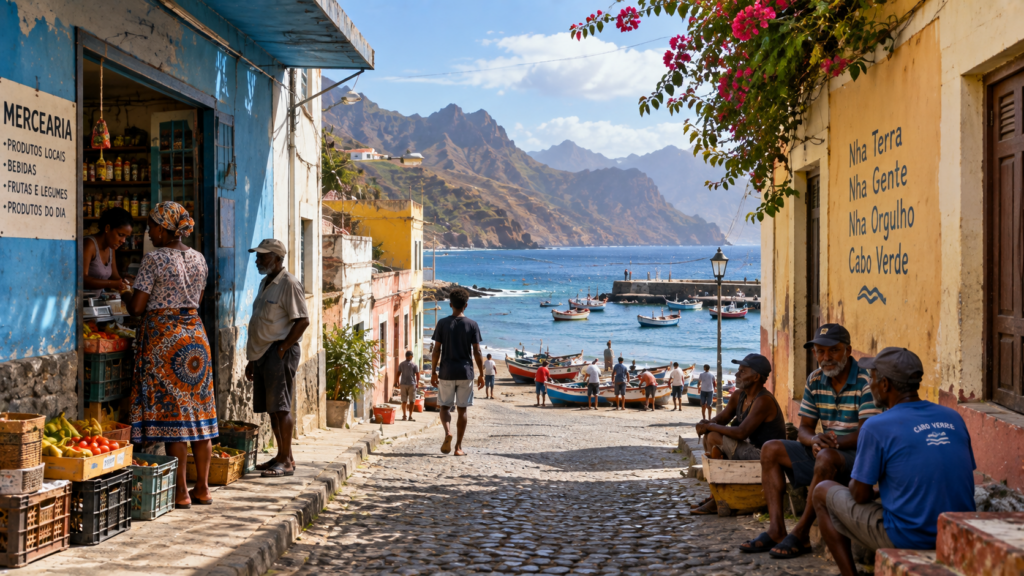
Which Cape Verde Island Should You Choose?
There is no useful answer to “Which is the best Cape Verde island?” without knowing what you want to do.
A better starting point is this.
Sal
Choose Sal if you want an easy beach base, watersports and a good concentration of tourism services. Santa Maria is the main centre, while Pedra de Lume, Buracona and the island’s dry interior are straightforward additions to a beach-focused trip.
Best fit: beaches, kitesurfing, windsurfing, diving and an uncomplicated first visit.
Boa Vista
Boa Vista suits travellers who still want beaches but prefer a more dispersed island with desert scenery, wildlife and excursions away from the main hotel areas.
Best fit: beaches, turtle and whale experiences, desert landscapes and 4×4 exploration.
Santo Antão
Come for the mountains. Hiking is central to many trips here, and the roads, valleys and villages make travelling through the island part of the experience.
There is no airport. The ferry connection with São Vicente therefore matters from the moment you start planning.
Best fit: hiking, mountain landscapes and village life.
São Vicente
Mindelo is the main reason many travellers choose São Vicente: music, restaurants, markets, cultural life and a waterfront city setting.
It is also the most logical gateway to Santo Antão.
Best fit: music, culture and a São Vicente + Santo Antão itinerary.
Santiago
Santiago gives you the broadest mix of city life, history and rural Cape Verde. Praia, Cidade Velha, the mountain interior and Tarrafal can all belong to the same trip.
Best fit: history, culture, markets and travellers who want more than a beach stay.
Fogo
The volcano dominates both the landscape and the way visitors experience Fogo. Pico do Fogo, Chã das Caldeiras, São Filipe and the island’s wine culture make it a strong choice for a trip with a clear focus.
Best fit: volcanoes, hiking, wine and dramatic geological landscapes.
Maio
Maio is quieter and less developed for tourism than Sal or Boa Vista. Long beaches, cycling, nature and a slower rhythm are the main reasons to go.
Best fit: quiet beaches and travellers who do not need a large tourism infrastructure.
São Nicolau
São Nicolau combines mountain scenery, hiking and smaller communities. It can appeal to walkers who want a less obvious alternative to Santo Antão.
Best fit: hiking and slower exploration.
Brava
Small, mountainous and reached by sea, Brava rewards travellers who are willing to plan around access rather than squeeze it into a rushed itinerary.
Best fit: villages, walking, viewpoints and combining with Fogo.
Santa Luzia
Santa Luzia is uninhabited and protected. Access and permitted activities need to be checked against current environmental rules, treat it as a conservation topic rather than a normal sightseeing stop.
For a fuller comparison, see Which Cape Verde Island Should You Visit?
When Is the Best Time to Visit Cape Verde?
Cape Verde is a year-round destination, but there is no single best month for every kind of trip.
The drier period generally runs from around November to July. August to October is normally warmer and more humid, with a greater chance of rainfall.
That broad distinction is only the beginning.
A beach trip, hiking holiday, kitesurfing week and wildlife trip do not necessarily have the same ideal dates. Wind conditions matter for watersports. Temperatures matter when you are walking for several hours. Turtle and whale sightings are seasonal.
Before choosing dates, decide which of these matters most:
- beach conditions;
- hiking;
- wind and watersports;
- wildlife;
- festivals and cultural events;
- the specific islands in your itinerary.
The Best Time to Visit Cape Verde guide should be the next stop if your dates are still flexible.
How Many Days Do You Need in Cape Verde?
For one island, a week is easy to work with.
Once you start adding islands, the calculation changes. Transfer days begin to matter, and a second or third island may involve a domestic flight, ferry, road transfer or a combination of them.
As a practical starting point:
7 days: choose one island, or one very simple two-island combination.
10 days: two complementary islands usually make more sense than trying to collect three or four.
14 days: there is enough time for a more substantial multi-island trip, provided the connections work.
These are planning guidelines, not rules.
A São Vicente and Santo Antão trip is quite different from trying to combine Sal, Santiago and Fogo in the same number of days. Geography alone does not answer the question.
Transport does.
There is another useful way to think about it: count the days that remain after the transfers.
A second island may cost only an hour in the air or at sea, but the real transfer also includes getting to the airport or port, waiting, collecting luggage and reaching the next accommodation. That is why an itinerary can look relaxed on paper and feel much busier once you travel it.
If you already know how long you have, see How Many Days Do You Need in Cape Verde? for more detailed combinations.
Getting to Cape Verde
Cape Verde currently has four international airports:
- Nelson Mandela International Airport on Santiago;
- Amílcar Cabral International Airport on Sal;
- Aristides Pereira International Airport on Boa Vista;
- Cesária Évora International Airport on São Vicente.
The best arrival airport depends on the route you want to build.
For a single-island holiday this is straightforward. For a multi-island trip, the international flight can determine whether the rest of the itinerary is convenient or awkward.
Someone planning São Vicente and Santo Antão has a natural international gateway in São Vicente. A Santiago, Fogo and Brava itinerary starts from a different transport logic.
It’s worth settling the island combination first, then choosing the international flight to fit that plan rather than booking it as a separate decision.
Getting Around Cape Verde
There is no single transport system that works equally well everywhere.
Expect to use different options on different islands.
Domestic flights
Flights are useful for longer inter-island movements where current services exist.
They can save substantial time, but operators and schedules can change. Check the current service before building a connection around it.
Do not assume that because two islands have airports, there will be a convenient direct flight on the day you want.
Ferries
Ferries are an essential part of Cape Verde travel and the normal way to reach islands such as Santo Antão and Brava.
CV Interilhas publishes current routes and schedules. Use that timetable when fixing travel days rather than copying timings from an old itinerary or blog.
Some ferry combinations are simple enough to become part of the natural structure of a trip. São Vicente and Santo Antão is the obvious example.
Others need more thought.
Taxis
Taxis are useful for airport and ferry transfers, day trips and routes where shared transport does not fit your schedule.
They can also make more sense than renting a car when you only need transport on specific days.
Aluguers
Aluguers are shared minibuses or vehicles and form an important part of local transport.
They are useful precisely because they operate around local demand rather than as a rigid tourist transport system. That also makes them difficult to describe with one national timetable.
Routes and habits vary between islands, and sometimes between routes on the same island. A direct connection may be easy at one time of day and require a change of vehicle later.
Santo Antão is a good example. Recent traveller reports describe some services around Porto Novo working conveniently with ferry movements, while other journeys may involve changing in Ribeira Grande. Treat that as an illustration of how the system works, not as a permanent timetable.
Aluguers are a good option when your day has some flexibility. If you need to reach a ferry, airport or booked activity at a fixed time, check locally how that particular route normally works before relying on one.
Rental cars
A car can be convenient on some islands, but renting one automatically for an entire Cape Verde trip makes little sense.
Think about what you will actually do with it. Many walking routes on islands such as Santo Antão, Fogo, Santiago and São Nicolau are point-to-point rather than circular. Driving to the start of a trail is less useful if the walk finishes several kilometres away.
For a road-based sightseeing day, a rental car may give you useful independence. For a hiking itinerary, a combination of taxi, driver or local transport can be simpler.
Road conditions, mountain terrain, parking and the distances involved should all influence the decision.
Cape Verde Island Hopping: What Is Actually Realistic?
Cape Verde is well suited to island hopping. The difficulty is deciding when another island improves the trip and when it simply adds another transfer.
Start with combinations that have a practical reason to exist.
São Vicente + Santo Antão is the clearest example. The ferry crossing links Mindelo with Porto Novo and joins two islands that offer very different experiences: urban culture and music on one side, mountain landscapes and hiking on the other.
Fogo + Brava also makes geographical and logistical sense. Brava has no airport, so Fogo naturally becomes part of many routes that include it.
Santiago + Fogo can create a strong history-and-volcano combination, provided the current flight or ferry options fit the dates.
Other combinations need more scrutiny. Sal and Boa Vista look close on a map, for example, but the existence of a route does not automatically make the connection a good use of a short holiday.
Count travel days, not only nights. Several flights, ferries and accommodation changes inside a ten-night itinerary can use up more of the trip than the night count suggests, and you also need room for a connection that moves, runs late, or leaves you with an awkward half-day.
For that reason, avoid building important international departures around unnecessarily tight inter-island connections. A little margin near the end of a multi-island trip is rarely wasted.
Check current ferry and flight connections before fixing the accommodation around them, rather than trying to make the transport fit an itinerary you have already booked.
See the full Cape Verde Island Hopping Guide before fixing a multi-island route.
Entry Requirements, EASE and TSA
Entry requirements depend on nationality and travel circumstances.
Cape Verde has visa exemptions for nationals of a number of countries, but foreign travellers may still need to complete pre-registration through the official EASE system and pay the Airport Security Fee, or TSA, when applicable.
Before travelling:
- check the current visa rules for your nationality;
- confirm passport requirements;
- complete the required EASE pre-registration;
- check whether TSA applies to you.
These rules can change.
Use the official Cabo Verde government information rather than an old travel article.
Our Cape Verde Entry Requirements guide explains the process in more detail.
Money in Cape Verde: Cash, Cards and Euros
The official currency is the Cabo Verdean Escudo (CVE).
Euros are commonly useful in tourism areas, and many larger hotels, restaurants and supermarkets accept cards. ATMs are available in the main towns and tourism centres.
That does not make cash unnecessary.
Smaller businesses, local transport and travel away from the main tourist areas are good reasons to have access to escudos.
For a multi-island trip, assuming that every payment can be made by card is less convenient than simply carrying an appropriate amount of local cash.
See Cape Verde Currency: Cash, Cards, ATMs and Euros for the practical details.
Language and Local Culture
Portuguese is the official language. Cabo Verdean Creole, usually called Kriolu, is the language you are more likely to hear in everyday conversation.
The exact form of Kriolu varies between islands.
Music is central to Cape Verdean culture, with morna among the country’s best-known musical traditions. Mindelo is particularly associated with live music and the cultural life of São Vicente.
You will also come across the word morabeza, commonly associated with Cape Verdean warmth and hospitality.
You do not need to speak Portuguese or Kriolu to organise most tourist services. Learning a few words is still useful.
What Should You Eat in Cape Verde?
Start with cachupa.
It is a slow-cooked dish based around maize and beans, with different versions depending on ingredients and occasion.
Fresh fish and seafood are also important, while maize, beans and locally available produce appear throughout Cape Verdean cooking.
Grogue, a sugarcane spirit, is strongly associated with islands such as Santo Antão. Fogo has its own wine tradition linked to the volcanic landscape around Chã das Caldeiras.
Food does not need a complicated itinerary. Leaving the hotel for a local restaurant is often enough to start.
Health and Safety
Most visitors should approach Cape Verde with the same basic precautions they would use elsewhere: look after valuables, understand local transport, respect sea conditions and check current official travel advice before departure.
Do not assume that every attractive beach is suitable for swimming. Conditions vary by location.
Food and drinking-water precautions are also sensible, and travel insurance that covers medical care should be considered before the trip.
Health and safety advice can change. Check the current official guidance rather than relying on a permanent statement in any travel guide.
What to Pack for Cape Verde
Pack for the itinerary rather than the country name.
A week based in Santa Maria needs different footwear from five days of hiking in Santo Antão.
Common essentials include:
- light clothing;
- sun protection;
- swimwear;
- a layer for wind or cooler evenings;
- suitable walking shoes if hiking;
- essential medication;
- travel documents and insurance details;
- access to some local cash.
If you are moving between several islands, lighter luggage makes repeated ferry, airport and road transfers easier.
The full Cape Verde Packing List goes into activity-specific details.
Start With the Trip, Then Choose the Islands
A first-time visitor does not need to see half of Cape Verde to understand the country.
Beaches and simple logistics point to Sal or Boa Vista.
São Vicente and Santo Antão are the strongest pairing for hiking and culture together.
Santiago gives you more history and everyday life than any other single island.
Fogo is worth the extra planning once the volcano, the hiking or the wine matters enough to earn it proper time.
The quieter islands — Maio, São Nicolau, Brava — only really work once speed has stopped being the measure of a good trip.
Not sure which islands fit your trip?
Tell us how many days you have, what you want to do and how much travelling you are comfortable with. A local Cabo Verde travel expert can help you build a realistic itinerary.
Frequently Asked Questions
Is Cape Verde worth visiting?
Cape Verde is particularly rewarding when the island matches your interests. It can be a straightforward beach destination, but the country also offers hiking, music, history, wildlife, volcanic landscapes and multi-island travel.
Which Cape Verde island is best for a first visit?
For an easy beach holiday, Sal is usually the simplest introduction. Boa Vista is another strong beach choice with more emphasis on excursions, wildlife and open landscapes.
For a trip focused on culture and hiking rather than beaches, consider São Vicente and Santo Antão together.
Which Cape Verde island is best for beaches?
Sal and Boa Vista are the obvious choices for a beach-focused trip.
Sal provides easier access to restaurants, watersports and services around Santa Maria. Boa Vista has extensive beaches and a more dispersed landscape.
Which Cape Verde island is best for hiking?
Santo Antão is the strongest hiking choice for most travellers because walking is central to the island’s tourism experience and there is a wide range of mountain and valley routes.
Fogo and São Nicolau are also worth considering for very different landscapes.
Is Sal or Boa Vista better?
Choose Sal if convenience, Santa Maria and watersports matter most.
Choose Boa Vista if you prefer long beaches, desert scenery, wildlife experiences and excursions across a more dispersed island.
Can you travel between Cape Verde islands?
Yes. Travel between islands uses domestic flights and ferries.
The important question is whether the current connection is convenient enough for your itinerary. Check live flight and ferry information before fixing accommodation around a transfer.
Can you island-hop in Cape Verde?
Yes, and several island combinations work particularly well.
Allow enough time. Two islands with sensible connections often produce a better ten-day trip than four islands that require constant transfers.
How many days should I spend in Cape Verde?
A week is enough for a good single-island trip.
Around ten days works well for many two-island combinations. Two weeks gives you more flexibility for a multi-island trip, but the right answer depends on transport and the islands involved.
What currency should I take to Cape Verde?
The official currency is the Cabo Verdean Escudo. Euros and cards are useful in many tourism areas, but local cash is sensible for smaller purchases and travel outside the main visitor centres.
Do I need a visa for Cape Verde?
That depends on your nationality and circumstances. Visa exemptions exist for a number of nationalities, while current EASE pre-registration and TSA requirements may still apply.
Check the official government information before travelling.