
Whale watching in Cape Verde is centred on one remarkable seasonal visitor: the humpback whale.
Every year, humpbacks reach the archipelago’s warm Atlantic waters to breed, give birth and care for calves. Boa Vista is the strongest base for travellers planning a trip specifically around them, while seasonal sightings also occur around Sal and other islands.
Timing matters.
Humpbacks may begin appearing from January and remain into May, while organised whale-watching activity is concentrated more heavily from February or March onwards. For travellers choosing dates primarily to see whales, March and April offer the strongest practical window.
Even then, sightings depend on wild animals and conditions at sea.
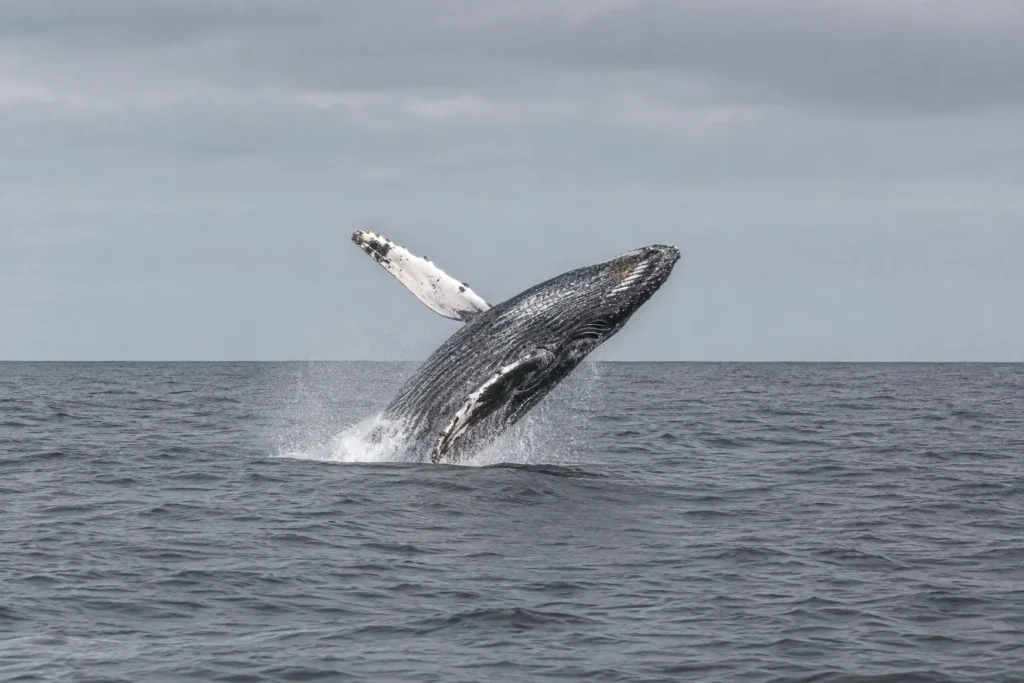
One trip may bring a mother and calf, several adults moving through the area, repeated tail flukes or dramatic surface behaviour. Another may involve a quieter encounter with animals travelling steadily through the Atlantic.
Cape Verde also regulates cetacean watching. Boats must keep minimum distances, observation time is limited, and swimming or diving with whales and dolphins is prohibited.
Responsible observation is part of the experience, particularly in breeding waters used by mothers and young calves.
Whale Watching in Cape Verde at a Glance
| Question | Practical Answer |
|---|---|
| Main whale species | Humpback whale |
| Best island for dedicated whale watching | Boa Vista |
| Biological presence | Mainly January–May |
| Main tour season | Roughly February/March–May |
| Best months for a whale-focused trip | March–April |
| Typical excursion | Around 2–4 hours |
| Sightings guaranteed? | No |
| Swimming with whales? | Prohibited |
| Minimum distance from adult cetaceans | 80 m |
| Minimum distance from whales with calves | 100 m |
| Best planning strategy | Book early in your stay |
Why Humpback Whales Come to Cape Verde
Humpbacks use Cape Verde mainly for breeding, calving and nursing.
They undertake long migrations between productive feeding areas at higher latitudes and warmer waters used during the reproductive season.
Cape Verde is one of the known North Atlantic breeding areas for humpback whales. Research around Boa Vista identified Sal Rei Bay as the most important known location for winter breeding, calving and nursing in the eastern North Atlantic.
This helps explain the behaviour visitors may encounter.
Possible observations include:
- mothers travelling with calves;
- adults moving through coastal waters;
- groups associated with breeding activity;
- tail flukes before deeper dives;
- pectoral fin or tail slapping;
- breaching;
- competitive groups;
- males singing below the surface.
The behaviour visible on each trip depends entirely on the animals present that day.
A whale surfacing several times before disappearing beneath the Atlantic can be just as characteristic of the season as a dramatic breach.
Best Time for Whale Watching in Cape Verde
Humpback whales are mainly present around Cape Verde from January into May.
For travel planning, it helps to distinguish the biological season from the period when dedicated excursions operate most consistently.
January and Early February
Humpbacks can already be present.
Dedicated tour schedules may still be limited, depending on the island and operator.
Travellers visiting at this time should confirm current availability before assuming daily departures.
Mid-February to May
This is the main practical whale-watching period used by many operators, especially on Boa Vista.
Tour schedules become more established as the season develops.
March and April
For travellers visiting Cape Verde specifically for humpback whales, March and April are the strongest months to target.
They sit comfortably inside the seasonal presence of whales and within the main operating period for dedicated excursions.
Sightings still depend on sea conditions, whale distribution and animal behaviour.
May
Whales can remain into May, although the season begins to taper.
Travellers whose main priority is whale watching gain more margin by travelling in March or April.
Boa Vista: The Best Base for Whale Watching
Boa Vista is the strongest practical base for a dedicated humpback-whale trip.
Scientific research has identified the waters around the island, especially the Sal Rei area, as important habitat for breeding, calving and mothers with young.
Boa Vista also has the clearest concentration of organised seasonal whale-watching excursions in Cape Verde.
Tours commonly depart from the Sal Rei / Estoril area, with hotel transfers included by some operators.
Depending on the company and trip, boats may include:
- RIBs;
- motorboats;
- yachts;
- catamarans.
Typical excursions last roughly two to four hours, with around three hours common.
Boa Vista therefore combines important humpback habitat with an established tourism infrastructure for observing the animals.
If whale watching is one of the main reasons for your Cape Verde trip, Boa Vista is the strongest choice.
Why Boa Vista Matters for Mothers and Calves
The shallow coastal waters around Boa Vista are used during the breeding season, including by mothers with young calves.
Young animals remain dependent on their mothers, making repeated disturbance especially important to avoid.
Cape Verde’s regulations therefore require greater separation when calves are present.
Boats must remain at least:
80 metres from adult cetaceans
and:
100 metres from whales accompanied by calves
These are minimum legal distances.
A good whale-watching excursion does not depend on reducing them.
The Cape Verde Islands/Northwest Africa humpback population is still listed as endangered by NOAA. In breeding waters where mothers and calves are present, limiting disturbance is particularly important.
Whale Watching from Sal
Humpback whales also occur around Sal during the season.
Seasonal sightings are reported from the island, including during other marine activities, and whale-oriented departures may be available.
The main difference is the tourism infrastructure.
Dedicated humpback whale watching is more established on Boa Vista.
For someone already staying on Sal in March or April, it makes sense to check current whale-watching availability.
For someone choosing an island primarily to see humpbacks, Boa Vista provides the more dependable base.
See Sal vs Boa Vista if whale watching is one of several factors influencing your island choice.
Whales Around Other Cape Verde Islands
Humpbacks occur beyond Boa Vista and Sal.
Cetaceans have been recorded throughout the archipelago, and humpbacks use waters around several islands during the seasonal breeding period.
Commercial whale-watching availability is much less consistent outside the main tourism areas.
On islands such as Maio, Santiago or São Vicente, sightings can occur, but travellers should confirm current local excursion options before designing a trip around them.
Boa Vista remains the strongest base for a dedicated whale-watching holiday.
What to Expect on a Whale-Watching Tour
The programme varies by operator and boat, but dedicated excursions usually begin with a briefing covering:
- safety;
- life jackets;
- sea conditions;
- expected duration;
- whale behaviour;
- viewing procedures;
- rules governing approaches to cetaceans.
The boat then searches areas where whales have recently been observed or where seasonal conditions make encounters more likely.
Finding them can take time.
Crew members watch for signs such as:
- blows;
- dorsal profiles;
- surface movement;
- tail flukes;
- recent information from other authorised boats.
When whales are located, the captain must follow the national viewing rules and control the vessel’s approach.
The purpose is to observe natural behaviour while limiting disturbance.
Whale Behaviour and Other Marine Life
A humpback encounter can take many forms.
You may see:
- a blow before the body becomes visible;
- several surfacing cycles;
- tail flukes before a deeper dive;
- a mother and calf travelling together;
- adults moving through the area;
- pectoral fin slapping;
- tail slapping;
- competitive groups;
- breaching.
Some trips may also encounter:
- dolphins;
- pilot whales;
- sea turtles;
- flying fish;
- seabirds;
- other marine life.
Cape Verde has rich cetacean diversity, but the main seasonal target of these excursions is the humpback whale.
Other species should be treated as possible additional sightings.
Wildlife Sightings Depend on the Day
Humpbacks are wild animals in the open Atlantic, so no excursion can guarantee a sighting.
Even in March or April, whales may be difficult to locate on a particular day.
Sea conditions can also prevent departures or make some areas inaccessible.
That uncertainty should influence the itinerary.
If whale watching is important, schedule the excursion early enough in your stay to leave room for a second attempt if necessary.
Book Whale Watching Early in Your Stay
If you spend five or seven nights on Boa Vista and whale watching is a priority, try to schedule the trip during the first part of the stay.
If conditions are too rough and the operator cancels, you may still have time to move the booking to another day.
Leaving the excursion until the final full day removes that flexibility.
The same principle applies to multi-island trips.
Avoid making the whale excursion dependent on one narrow window immediately before a flight to another island.
Choosing the Boat
Whale-watching trips around Boa Vista use several types of vessel.
The best choice depends on comfort, group size, mobility and the type of trip you prefer.
RIB
A RIB or Zodiac-style boat is fast and normally keeps passengers close to the water.
Possible advantages include:
- fast movement between search areas;
- smaller groups on some departures;
- unobstructed views;
- a direct connection with the sea.
It can also involve:
- more movement;
- less space;
- greater exposure to wind and spray;
- a more demanding ride for some children;
- less comfort for passengers with reduced mobility or a tendency to seasickness.
Catamaran or Larger Motorboat
Larger vessels can offer:
- more deck space;
- easier movement;
- more seating;
- shelter on some boats;
- greater comfort for certain families or travellers.
Some carry larger groups, depending on the excursion.
Boat size alone does not determine the quality of the trip.
Crew experience, passenger numbers, viewing practices and respect for the animals matter just as much.
Whale Watching with Children
Whale watching can be a memorable family experience, but minimum ages differ between operators.
Some accept relatively young children, while others set higher limits, especially on RIB excursions.
Before booking, check:
- minimum age;
- boat type;
- child-sized life jackets;
- trip duration;
- seating;
- shade;
- toilet availability;
- ease of boarding;
- expected sea conditions.
A three-hour excursion on open Atlantic water can be demanding for a child who is sensitive to motion.
Boat choice and the child’s tolerance for the sea should form part of the decision.
Seasickness and Atlantic Conditions
Whale watching takes place in the open Atlantic.
Even on a good day, the boat may move more than some passengers expect.
If you are prone to motion sickness, prepare before departure using the measures that normally work for you.
Practical preparation includes:
- eating appropriately before the trip and avoiding a very heavy meal;
- drinking enough water;
- using your usual motion-sickness precautions if needed;
- applying sun protection;
- taking a light layer or windproof jacket;
- securing hats;
- protecting phones and cameras from spray;
- following crew instructions throughout the trip.
Sun, wind and spray can occur together.
A warm day on land may feel considerably cooler once the boat is moving.
Anyone with medical concerns about motion-sickness medication should follow appropriate professional advice.
Whale-Watching Prices in Cape Verde
Prices vary according to:
- boat type;
- trip duration;
- group size;
- hotel transfer;
- food or drinks;
- guide;
- season;
- private or shared departure.
As a November 2026 reference, published shared whale-watching trips on Boa Vista commonly range from roughly €55 to €85 per adult, depending on the operator and what is included.
Prices can change.
When comparing excursions, check whether the price includes:
- hotel pickup;
- return transfer;
- drinks;
- snacks;
- guide or marine specialist;
- taxes or fees;
- cancellation or rebooking conditions.
Transfer and other extras can reduce the difference between two apparently different tour prices.
Cape Verde’s Whale-Watching Rules
Cape Verde introduced specific national regulations for cetacean watching in 2024.
The rules are designed to reduce disturbance and are particularly relevant in waters used for breeding, calving and nursing.
They cover minimum distances, observation time, vessel numbers, swimming and diving, and the behaviour of boats when cetaceans are nearby.
Minimum Distances
Boats must remain at least:
80 metres from adult cetaceans
and:
100 metres from whales accompanied by calves
Operators must also avoid interfering with the direction of travel of the animals.
If cetaceans show signs of disturbance, vessels should not continue pursuing them.
Time and Number of Boats
Whale watching is also limited by time and vessel numbers.
For whales, a vessel may remain within 500 metres for a maximum of 15 minutes.
After that, it must move beyond the 500-metre zone and cannot return to the same individual or group during that excursion.
No more than three vessels may remain within 500 metres of the same whale or group at the same time.
These restrictions reduce repeated pressure on the animals.
A captain who waits, moves away or leaves whales that are still visible may simply be complying with the rules.
Can You Swim with Whales in Cape Verde?
No. Cape Verde law prohibits swimming and diving with whales and dolphins, except for authorised scientific or cetacean-recovery purposes.
Commercial whale-watching experiences should therefore remain boat-based.
Entering the water for a closer encounter is not part of responsible whale tourism in Cape Verde.
When Whales Approach the Boat
Minimum distances regulate vessel behaviour.
Whales may occasionally approach a boat on their own.
When that happens, the operator should avoid manoeuvres that interfere with the animals’ path and follow the procedures required when cetaceans enter the minimum-distance zone.
The boat should not pursue an animal simply to prolong or improve the encounter.
Choosing a Responsible Whale-Watching Operator
Commercial cetacean-watching activities require appropriate authorisation from the environmental authorities.
The regulations also require trained crew and a guide or monitor on board to provide information about marine life and cetaceans.
A marine biologist or specialist can add further value, although an authorised excursion is not required to carry someone specifically described as a marine biologist.
Useful questions before booking include:
- Is the operator authorised for cetacean watching?
- What distance do you keep from adult whales?
- What distance do you keep from mothers with calves?
- How long do you remain with one whale or group?
- What happens if other boats are already observing the whales?
- Is there a guide or marine specialist on board?
- What happens if sea conditions are unsuitable?
- Can the excursion be moved to another day?
Claims about getting unusually close to whales should be treated cautiously.
A responsible operator should be able to explain how the trip follows Cape Verde’s viewing regulations.
Whale Watching from Shore
Whales are occasionally seen from land around Boa Vista and other islands.
A visible blow or surfacing animal offshore can be an unexpected addition to the trip.
Shore sightings are unpredictable, so travellers visiting specifically for humpbacks should still plan a dedicated excursion.
Binoculars can help if animals appear farther offshore.
Whale Watching and Turtle Watching
Cape Verde is important for both humpback whales and loggerhead sea turtles.
Their main tourism seasons fall at different times.
The strongest practical period for humpback whale watching is around March and April.
The main loggerhead nesting season occurs later, broadly during summer and early autumn, with organised nesting experiences concentrated in that period.
A trip designed around humpback whales is therefore usually too early for the main turtle-nesting season.
Sea turtles can still be present in Cape Verde’s waters, but seeing one at sea is a separate experience from observing nesting on the beach.
See Turtle Watching in Cape Verde when planning a wildlife-focused trip around the different seasons.
Whale Watching and Diving
Whale watching itself does not create the decompression restrictions associated with scuba diving.
If your itinerary includes both activities, the diving schedule can still affect onward transport.
For example:
diving → whale watching → domestic flight
must still respect the required post-dive interval before flying.
See Diving in Cape Verde for surface intervals, domestic flights and post-dive altitude considerations.
Whale Watching on a 7-Day Cape Verde Trip
If whale watching is a major priority during a seven-day trip, keeping the itinerary simple gives you more flexibility.
Several nights on Boa Vista provide:
- more than one possible day for the whale excursion;
- beach time;
- other island activities;
- room to reschedule after a weather cancellation.
Adding too many islands reduces that margin.
If you combine Boa Vista with another island, account for the complete transfer rather than only the scheduled flight time.
See our Cape Verde 7-Day Itinerary for wider planning.
Whale Watching on a 10- or 14-Day Trip
A longer itinerary makes it easier to include Boa Vista without building the entire holiday around one excursion.
Place the whale-watching trip early in the Boa Vista stay and keep spare time available in case sea conditions require a change.
Ten or fourteen days can also combine Boa Vista with:
- Sal;
- Santiago;
- São Vicente;
- Santo Antão;
- Fogo;
depending on current flight schedules and the pace of the trip.
See:
- Cape Verde 10-Day Itinerary
- Cape Verde 14-Day Itinerary
- Domestic Flights in Cape Verde
for the wider transport structure.
Boa Vista and Sal Compared for Whale Watching
If humpback whales are a central reason for travelling, choose Boa Vista.
Sal has seasonal sightings and may offer whale-oriented excursions, but dedicated whale-watching infrastructure is stronger on Boa Vista.
If whales are only one part of the trip, compare the wider experience.
Sal offers Santa Maria, diving, watersports and a concentrated range of restaurants and independent activities.
Boa Vista combines the stronger whale-watching proposition with long beaches and a more dispersed resort geography.
See Sal vs Boa Vista for the full comparison.
Plan Your Cape Verde Wildlife Trip
Tell us:
- your travel dates;
- number of travellers;
- ages of any children;
- islands you are considering;
- whether whale watching is a priority;
- whether you also want beaches, diving, hiking or watersports;
- whether you prefer a resort, hotel or independent accommodation;
- how many islands you want to visit;
- whether you are interested in other wildlife experiences.
We can help fit the whale-watching season into the wider itinerary and combine islands, accommodation, transfers, wildlife experiences and onward travel around the time available.