
Sal is one of Cape Verde’s most accessible islands for a beach-focused stay, and it also fits neatly into a longer journey across the archipelago.
Most first-time visitors stay in Santa Maria, where the beach, restaurants, accommodation and many activity providers are within a relatively small area. From there, the rest of the island can be explored by taxi, private transfer, rental car or an organised island circuit.
How long you need depends largely on the role Sal will play in your trip.
Three or four days are enough when the island forms part of a multi-island itinerary. Five to seven days suit travellers coming mainly for beach, watersports and a slower schedule.
Sal also has a history and landscape beyond its resort coast. Pedra de Lume recalls the salt industry that shaped the island’s early settlement and economy, while Espargos, Palmeira and the volcanic interior add context to a stay centred on Santa Maria.
Sal at a Glance
| Best for | Beaches, watersports and relaxed holidays |
| Main base | Santa Maria |
| Highest point | Monte Grande, 406 m |
| Multi-island stay | 3–4 days |
| Sal-focused stay | 5–7 days |
| Airport | Amílcar Cabral International Airport |
| Rental car essential? | No |
| Historic highlight | Pedra de Lume salt pans |
| Kitesurfing / windsurfing season | Generally November to May |
Sal is relatively flat by Cape Verde standards. Monte Grande, at 406 metres, is the island’s highest point.
That compact geography makes it possible to stay in the same accommodation throughout the trip. Travellers based in Santa Maria can devote one day to seeing more of the island and keep the remaining days for the coast and whatever activities brought them to Sal.
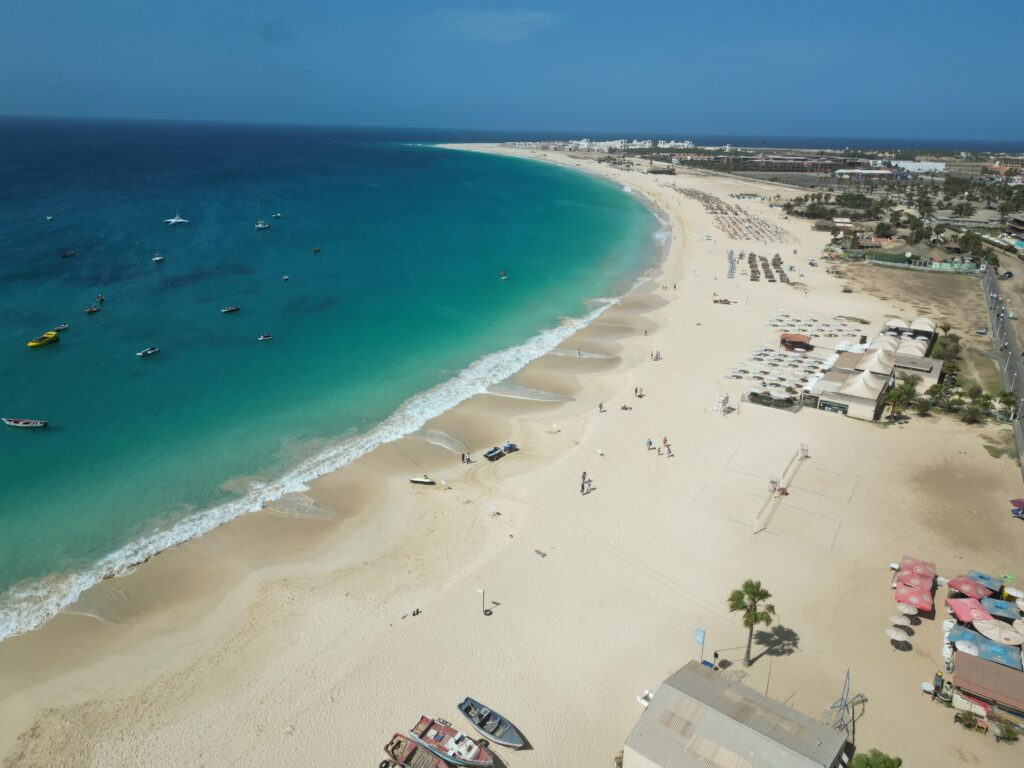
How Many Days Do You Need in Sal?
Two Days: A Short Introduction
Two days can work when Sal is mainly an arrival point, departure point or short beach stop within a longer Cape Verde itinerary.
One day can be spent around Santa Maria and the coast, with the second reserved for an island circuit.
There is little room left for activities that need their own time, such as diving, a kitesurfing lesson or a boat excursion. A two-day stay is therefore best treated as an introduction.
Three to Four Days: Sal in a Multi-Island Trip
Three or four days fit comfortably into a journey involving other Cape Verde islands.
A useful structure is:
| Day | Plan |
|---|---|
| 1 | Arrival and Santa Maria |
| 2 | Island exploration |
| 3 | Beach or chosen activity |
| 4 | Extra beach time, watersports or departure |
This is also how Sal can work well after several more active days elsewhere.
In programmes combining Santiago and Sal, for example, the island can provide beach time after historical sites, markets and inland travel. Following São Vicente and Santo Antão, it can serve as a quieter final stage after Mindelo and several days in the mountains.
Five to Seven Days: A Sal-Focused Holiday
Five to seven days suit travellers whose holiday is centred on Sal.
The value of the extra time lies in having fewer fixed commitments. A week can include an island tour, watersports, diving, a boat trip, several beach days and evenings in Santa Maria without scheduling an organised activity every morning.
This rhythm is one of Sal’s strengths.
A large amount of what visitors need is readily available around Santa Maria: accommodation, restaurants, beach access and activity operators. Some days can therefore remain completely open until you arrive.
More Than a Week
Longer stays suit travellers who deliberately want a slow beach holiday or need flexibility for an activity practised over several days.
This is relevant for kitesurfing, windsurfing and diving, where sea or wind conditions can affect the best day for a session.
Families and travellers who enjoy extended periods with little scheduled may also prefer a longer stay.
Beyond a week, additional nights are more about pace than adding new sightseeing stops.
Where Should You Stay in Sal?
For most first-time visitors, Santa Maria is the natural base.
Santa Maria
Santa Maria combines a long sandy beach with restaurants, shops, activity operators and a large share of the island’s visitor accommodation.
Much of daily holiday life can happen on foot.
This is useful for travellers who want access to the beach during the day but still prefer restaurants, shops and some activity in the evening.
Staying in Santa Maria also means that exploring the rest of Sal becomes a choice for one or two days rather than something you need to organise every morning.
Resort Areas Around Santa Maria
Larger resort properties extend along the southern coast, including areas towards Ponta Preta and Ponta do Sinó.
They may suit travellers whose holiday revolves around the hotel, pools, beach facilities and all-inclusive services.
Check the exact location if you expect to walk into Santa Maria regularly. A property that appears close on an island map can still mean frequent taxi journeys for dinners or evenings in town.
Murdeira
Murdeira offers a quieter coastal setting between Santa Maria and the centre of the island.
It can suit travellers who prefer a less active environment and are comfortable arranging transport when they want to visit Santa Maria or other parts of Sal.
The location is more relevant to travellers who deliberately want that quieter setting than to someone seeking maximum convenience.
Espargos
Espargos is the island’s capital and sits close to the airport.
It reflects everyday life on Sal more directly than the main resort areas and can be useful for specific travel needs.
For a beach-centred holiday, however, staying there means travelling south whenever you want Santa Maria and its coast.
How to Get to Sal
Sal is served by Amílcar Cabral International Airport, near Espargos.
The airport handles domestic and international traffic and remains one of Cape Verde’s principal aviation gateways.
Official aviation information places it roughly three kilometres south of Espargos.
The road transfer to Santa Maria is straightforward, so travellers arriving by air can normally reach their accommodation without complicated onward logistics.
Airline routes and domestic frequencies can change. Check the options operating on your actual travel dates before building a multi-island itinerary around a presumed connection.
Arriving by Ferry
Sal is also connected to the inter-island ferry network.
Sea travel can be useful on some routes, although journey times vary considerably. The Sal–Boa Vista crossing is much shorter than connections involving islands farther west or south.
For island hopping, compare the ferry and domestic flight options available on your dates rather than treating one form of transport as the default.
Our How to Get Around Cape Verde guide covers this decision in more detail.
Getting Around Sal
A holiday based in Santa Maria does not require a rental car.
Around Santa Maria
The town is walkable for many everyday journeys.
Beach access, restaurants, shops and numerous activity providers are close enough together that visitors can spend full days without arranging transport.
Taxis and Private Transfers
Taxis are widely useful for airport journeys and individual trips elsewhere on the island.
If you want to combine several places during the same day, an arranged driver or guided island tour is often more efficient than organising separate journeys between each stop.
Rental Car
A car suits travellers who want to set their own route and timetable.
For someone staying in Santa Maria and planning only one day of island exploration, renting for the whole holiday may add more organisation than value.
Choosing transport only for the days when you need it keeps the rest of the stay uncomplicated.
How Much of Sal Should You Explore Beyond Santa Maria?
For a first visit, reserve one full day to see more of the island.
Sal’s size means that several areas can be combined in the same outing. A typical circuit may pass through places such as Palmeira, Buracona, Terra Boa, Espargos and Pedra de Lume before returning towards the south.
The purpose of that day is broader than collecting attractions.
It shows how quickly the resort landscape around Santa Maria gives way to dry volcanic terrain, working communities and places linked to the island’s earlier economy.
Our Things to Do in Sal guide covers individual stops, activities and ways to organise them in greater depth.
Pedra de Lume and Sal’s Salt History
Pedra de Lume adds historical context to an island now strongly associated with tourism.
The salt pans occupy the crater of an extinct volcano. Salt extraction played a major role in the settlement and economic development of Sal from the late eighteenth century onwards.
The site preserves evidence of the infrastructure and community that developed around the salt industry.
The salt pans were classified as National Heritage in 2012 and have appeared on Cabo Verde’s UNESCO World Heritage Tentative List since 2004.
For the traveller, the importance of Pedra de Lume goes beyond the unusual setting.
It helps explain the island’s name and provides a glimpse of an economy that existed long before Santa Maria became an international tourism centre.
Details about visiting the site belong in our Things to Do in Sal guide.
How Much Beach Time Should You Plan?
On Sal, beach time can form a substantial part of the trip.
Santa Maria’s coastline makes it easy to combine swimming, walking, meals and other activities without travelling elsewhere.
Other coastal areas become relevant for more specific reasons.
Kite Beach is closely associated with wind sports. Ponta Preta is known for surfing and more powerful sea conditions. Murdeira has a quieter coastal character.
For travellers choosing Sal mainly for the sea, there is no need to turn every free day into another excursion around the island.
One exploration day can provide context. The remaining time can be shaped around beach, weather and whatever activities interest you.
For a wider comparison of beaches across the archipelago, see our Best Beaches in Cape Verde guide.
Planning a Kitesurfing or Windsurfing Trip
Sal is one of Cape Verde’s principal islands for kitesurfing and windsurfing.
The general season runs from approximately November to May, with the strongest winds usually occurring between January and April.
Travellers coming mainly for wind sports should build some flexibility into the trip.
Several available days give instructors and participants more scope to choose appropriate conditions than a single session fixed far in advance.
Accommodation choice can also change.
Someone planning daily sessions may care more about the chosen school, transport arrangements or access to a particular beach than about staying in the most central part of Santa Maria.
Beginners should check conditions with the chosen operator rather than selecting travel dates simply because stronger wind is forecast for that part of the year.
Diving and Other Water Activities
Diving, snorkelling and boat activities are widely available around Sal.
They fit easily into a longer stay because they can occupy half a day or a full day without requiring a change of base.
Travellers coming specifically to dive should look at sites, certification requirements and operator choice separately from general island planning.
When Is the Best Time to Visit Sal?
Sal can be visited throughout the year.
Cape Verde’s climate is generally dry, with the longest dry period running roughly from November to July. The greater chance of rain falls between August and October, although rainfall remains limited and irregular on Sal.
The best travel period therefore depends more on the activity than on a narrow weather window.
For a Beach Holiday
Much of the year works well.
Travellers who prefer the most consistently dry conditions often choose dates within the long dry season.
For Kitesurfing and Windsurfing
The wind calendar matters more.
November to May is the broader season, with January to April generally bringing stronger conditions.
For Wildlife
Seasonal wildlife can affect the timing of some activities.
Sea turtles nest on Sal and several other Cape Verde islands during a season that broadly runs from June to October.
Any turtle-watching activity should follow current conservation rules and be organised responsibly.
Sal or Boa Vista?
Sal and Boa Vista are often considered by travellers looking for a beach-led Cape Verde holiday.
The comparison deserves its own article because the decision involves more than the quality of the beaches.
For this guide, the most relevant distinction is how a visitor uses the island.
Santa Maria places restaurants, accommodation, activities and a large stretch of beach within a relatively contained visitor area. On Boa Vista, excursions and movement through a wider island landscape tend to play a larger role in the experience.
That is enough to affect accommodation, transport and daily planning.
If you are choosing between the two, see our dedicated Sal vs Boa Vista guide for the full comparison.
Combining Sal with Other Cape Verde Islands
Sal’s international airport and beach infrastructure make it easy to use as one stage of a longer trip.
It can work at the beginning, although placing it at the end has an obvious appeal after several days involving road travel, hiking and accommodation changes.
Santiago + Sal
Santiago and Sal create a varied eight-day journey.
Santiago brings Praia, Cidade Velha, markets, rural communities and inland landscapes. Sal then shifts the pace towards Santa Maria, an island circuit and free time beside the sea.
Our Cape Verde Essentials – 8 Days follows this route.
Explore Cape Verde Essentials
São Vicente + Santo Antão + Sal
Travellers interested in Mindelo and the mountains of Santo Antão can finish the journey on Sal.
Our Mountains to Beach – 8 Days combines São Vicente, Santo Antão and Sal, moving from urban culture through mountain landscapes to the coast.
See Mountains to Beach
Sal + Boa Vista
Sal and Boa Vista are geographically close, but a two-island holiday still needs to be designed around the transport that actually operates during your stay.
Check flights and ferries before committing to accommodation on both islands.
The forthcoming Sal vs Boa Vista guide can also help decide whether visiting both adds enough to the trip or whether one of them already fits what you want.
Sal in a Seven-Day Holiday
A week on Sal can be a complete trip.
Travellers focused on beach, watersports and relaxation do not need to add another island simply to make the itinerary feel substantial.
A typical week leaves time for one island circuit, one or two organised activities and several unscheduled days around Santa Maria.
If another Cape Verde island is a genuine priority, then the journey can be worth the extra transport.
Our 7-Day Cape Verde Itinerary looks at that broader question across the archipelago.
A Practical Sal Plan
For a first stay, base yourself in Santa Maria unless a specific activity or accommodation preference points elsewhere.
Reserve one full day to explore beyond the south coast. Use the remaining time according to the reason you chose Sal: beach, diving, watersports or simply a slower schedule.
Three or four days fit easily into a multi-island journey. Five to seven days suit a holiday centred on Sal itself.
If the trip includes another island, confirm the flight or ferry operating on your dates before arranging accommodation around a tight connection.
Travellers looking for a ready-made combination can consider Cape Verde Essentials – 8 Days, which combines Santiago and Sal, or Mountains to Beach – 8 Days, linking São Vicente, Santo Antão and Sal.
If you prefer to build the journey around your own dates and interests, tell us how many days you have, which islands interest you and what you want from the trip.