
Santo Antão is an island where the way you plan the stay changes what you experience.
There is no airport. Most visitors arrive by ferry from São Vicente, through Porto Novo. From there, roads climb into volcanic mountains, cross high ridges and descend towards cultivated valleys and the north coast. The place you choose to stay affects which parts of the island are easy to explore and how much time you spend travelling each day.
For hikers, Santo Antão can fill an entire holiday. But the island also works remarkably well for travellers who prefer scenic drives, shorter walks, rural landscapes, local food and time in small towns and villages.
The Estrada da Corda crosses some of the island’s most dramatic mountain terrain. Cova opens onto a volcanic crater cultivated on its floor. Paul and Ribeira da Torre combine steep geology with terraced agriculture. Ponta do Sol and Fontainhas bring the mountains to the Atlantic coast. Markets, grogue production, local food and religious traditions add context to the landscapes around them.
Santo Antão covers 779 km², making it Cabo Verde’s second-largest island. Its highest point, Tope de Coroa, reaches 1,979 metres. Those numbers only tell part of the story. Mountain roads and deep valleys make travel time more important than straight-line distance.
This guide focuses on the decisions that shape a first trip: how to get there, how long to stay, where to base yourself, how much hiking to include and how Santo Antão fits with São Vicente and the rest of Cabo Verde.
Santo Antão at a Glance
| Santo Antão | Quick Answers |
|---|---|
| Best for | Mountain landscapes, hiking, rural life, scenic drives and local culture |
| How to get there | Ferry from São Vicente to Porto Novo |
| Good first stay | Around 3 nights |
| More complete stay | 4–5 nights |
| Main bases | Paul, Ribeira Grande, Ponta do Sol |
| Best hiking period | October to May |
| Car essential? | No |
| Main gateway | Porto Novo |
| Beach destination? | Beaches exist, but mountains and valleys are the main attraction |
A short stay works when you choose carefully. Extra days add more than additional sights: they give you more freedom over where to walk, where to stay and how slowly to explore the island.
How to Get to Santo Antão
Santo Antão has no operating airport.
The usual journey is:
São Vicente → Mindelo port → ferry → Porto Novo
For most international visitors, São Vicente is therefore the natural gateway to the island.
The ferry crossing takes about an hour, depending on the service, and current departure times should be checked for the travel date. Schedules can vary, so the ferry works best when it is treated as part of the itinerary from the beginning rather than added after flights and accommodation have already been fixed.
Porto Novo is the island’s main port and the starting point for most onward journeys.
From there, travellers heading towards Paul, Ribeira Grande or Ponta do Sol immediately begin crossing some of Santo Antão’s most impressive terrain. The transfer to the north or northeast can therefore become part of the first day’s experience rather than simply time spent getting to the hotel.
São Vicente also gives the journey another dimension. Mindelo can add restaurants, music, markets and urban culture before or after several days among Santo Antão’s valleys and mountains.
Our guide to How to Get Around Cape Verde covers the broader inter-island transport system.
How Many Days Do You Need in Santo Antão?
The useful length depends on how much choice you want once you arrive.
Two Nights: A Selective First Experience
Two nights can work well when Santo Antão forms part of a shorter Cape Verde itinerary.
There is time to cross the mountain interior, explore one or two of the main valleys and include either a meaningful walk or a broader sightseeing day.
The trade-off is selection.
With only two nights, trying to combine Paul, Ponta do Sol, several hiking routes, the western side of the island and long cultural stops would quickly turn the stay into a sequence of transfers.
Choose the part of Santo Antão that matters most to you and give it enough time.
Three Nights: A Good First Visit
Three nights provide a much more flexible introduction.
A traveller can combine a substantial hiking day with scenic and cultural exploration, or spend several less physically demanding days moving through different parts of the north and northeast.
This also makes the choice of base more meaningful.
Instead of treating Santo Antão as a long excursion from São Vicente, you wake up inside one of its valleys or coastal towns and begin the next day from there.
For many first-time visitors, three nights are enough to understand why Santo Antão feels so different from the flatter islands of Cabo Verde.
Four to Five Nights: The Best Balance for Many Active Travellers
Four or five nights create room for different kinds of days.
One might involve a long hike. Another can follow the Estrada da Corda, visit Cova and continue towards the north. Time in Paul or Ribeira da Torre can focus more on agriculture, villages and local production. Ponta do Sol and the north coast can have a day of their own.
The additional time also creates useful flexibility.
Weather, cloud or trail conditions can affect a mountain day without forcing the whole itinerary to change.
For travellers who enjoy being active but also want time for food, towns, conversations and unplanned stops, this is often the strongest range.
Six to Seven Nights or More: A Slower Santo Antão
A week opens the island further.
Several hiking days can sit alongside quieter exploration, and more remote areas begin to make practical sense.
This is where places such as Tarrafal de Monte Trigo become easier to include. Reaching them takes time, but a longer stay allows that journey to become part of the experience rather than another long transfer squeezed between better-known valleys.
A slower pace also gives ordinary island life more room to enter the trip: markets, cafés, local producers, villages and conversations that rarely fit neatly into a packed sightseeing schedule.
Can You Visit Santo Antão on a Day Trip from São Vicente?
A full-day excursion from São Vicente can give you a surprisingly broad introduction to Santo Antão.
With an early ferry and organised transport from Porto Novo, the day can cross the mountain interior and continue through places such as Cova, Ponta do Sol, Fontainhas and the Paul Valley before returning to the port.
This works particularly well for travellers based in Mindelo who have limited time or who want to experience Santo Antão’s landscapes without changing accommodation.
Our Santo Antão Island Tour follows this logic: the ferry is combined with private transport across the island, mountain viewpoints, northern communities, Paul and a visit connected to local grogue production.
The day provides a strong overview because Santo Antão changes so dramatically over relatively short distances.
Several nights create a different experience.
There is time for longer hikes, quieter mornings, more freedom over weather and trail conditions, and evenings in the valleys or coastal towns after day visitors have begun returning towards Porto Novo.
For travellers who have made Santo Antão one of the main reasons for coming to Cabo Verde, staying on the island usually provides much more room to enjoy it.
Understanding Santo Antão Before Choosing Where to Stay
Santo Antão changes character as you cross it.
Understanding those differences makes choosing a base much easier.
Porto Novo and the Drier South
Porto Novo lies on the island’s drier southern side and is the main maritime gateway.
The landscape around the port is markedly different from the green valleys most often associated with Santo Antão.
Roads heading north climb through increasingly mountainous terrain, while routes west lead towards drier valleys and more dispersed communities.
This southern landscape is useful context. The greenery of Paul becomes more striking after travelling through Santo Antão’s arid side rather than appearing as the island’s default condition.
The Mountain Interior
The old Estrada da Corda crosses some of Santo Antão’s most dramatic high ground.
Cova, forested sections, steep valleys and viewpoints such as Delgadinho appear along the route between the Porto Novo side and the north.
A journey here can be an activity in itself.
The road constantly changes elevation and perspective, which also explains why travel times on Santo Antão are difficult to judge from map distance alone.
Paul and the Green Valleys
Paul is one of Santo Antão’s defining landscapes.
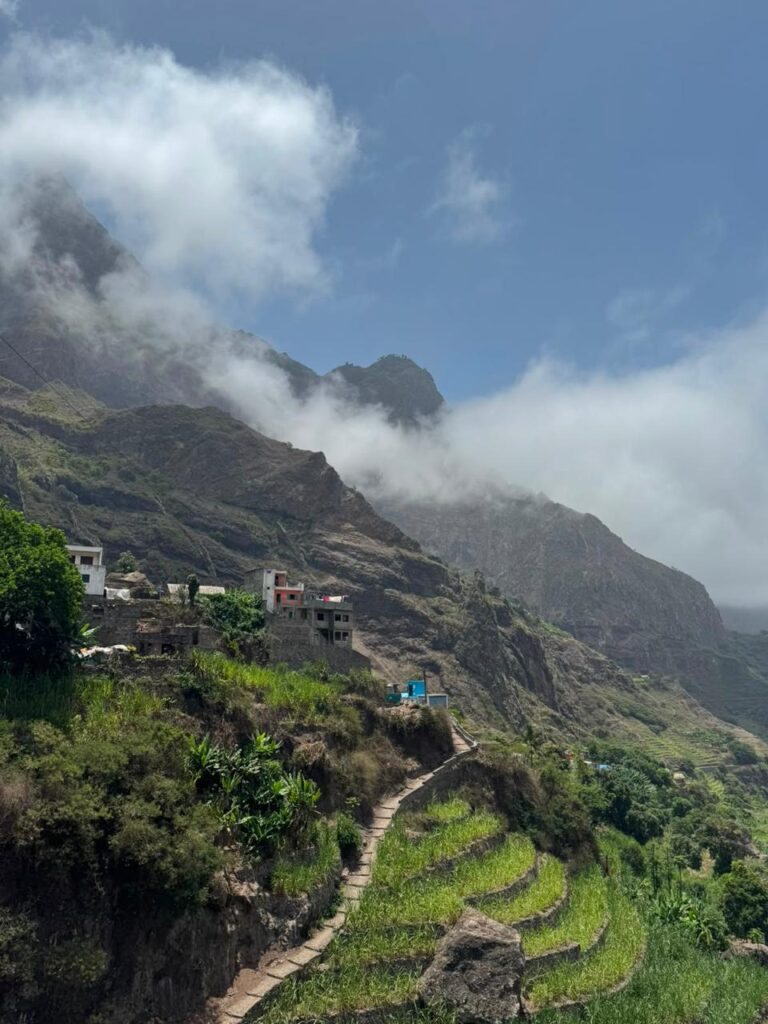
Steep slopes are cut into agricultural terraces, with sugarcane, bananas and other crops growing throughout the valley. Villages, paths and cultivated land occupy the same terrain.
Ribeira da Torre offers another version of the northeastern mountain landscape, enclosed by high rock walls and filled with cultivated ground and small communities.
The agriculture helps explain why these valleys look the way they do.
Sugarcane leads naturally to grogue production. Terraces reflect generations of working steep land. Local produce appears later in markets, restaurants and homes.
The scenery and the way people live within it belong to the same landscape.
The North Coast
Ponta do Sol and the surrounding north coast bring the mountains directly to the Atlantic.
The town can serve as a base for coastal walks and journeys towards places such as Fontainhas, while also offering a compact coastal setting for travellers who want cafés, restaurants and village life near the sea.
The terrain becomes particularly dramatic where settlements occupy narrow ledges and steep slopes above the coast.
The Remote West
Western Santo Antão fits a slower itinerary.
Tarrafal de Monte Trigo lies far from the northeastern valleys that dominate many first visits and offers a different combination of dry terrain, coast and relative isolation.
The journey itself requires time.
For that reason, the west becomes much more attractive once the stay is long enough to give it proper space.
Where to Stay in Santo Antão
Your base determines how each day begins.
For a first stay of three or four nights focused mainly on the north and northeast, choosing one base is usually simpler than changing accommodation every night. A second base becomes more useful on longer trips or when places such as Tarrafal de Monte Trigo form part of the plan.
Paul
Paul places you directly inside one of the island’s great agricultural valleys.
Hikers benefit from access to important walking areas, but the location also works well for travellers who simply want to spend several days surrounded by rural Santo Antão.
Cultivated slopes, villages, mountain roads and local producers are part of the immediate environment rather than stops on a day excursion.
Paul is particularly appealing when the valley itself is one of the reasons for choosing Santo Antão.
Ribeira Grande
Ribeira Grande provides a practical base for exploring several parts of the north and northeast.
Paul, Ribeira da Torre and the north coast are all relatively accessible, while the town offers more everyday services than a stay deep inside one of the valleys.
Its municipal market, the largest on Santo Antão according to the official tourism authority, also gives travellers an easy glimpse of the produce and commerce connected to the agricultural landscape around them.
Ribeira Grande works especially well for travellers who want geographic flexibility from one base.
Ponta do Sol
Ponta do Sol combines coast, town and easy access to some of northern Santo Antão’s best-known walking areas.
It is a strong choice for travellers who want evenings by the sea and access to places such as Fontainhas and the coastal trails during the day.
The atmosphere is different from Paul.
Rather than sleeping inside a cultivated valley, you stay where the mountain landscape reaches the Atlantic.
Porto Novo
Porto Novo is useful for ferry logistics, early departures and exploration of the island’s southern and western side.
Travellers concentrating on Paul, Ribeira Grande or Ponta do Sol generally gain more from staying in the north or northeast and treating the journey from Porto Novo as part of their first exploration of the island.
For some itineraries, however, a night close to the port can simplify an early ferry or a journey towards the west.
Tarrafal de Monte Trigo
Tarrafal suits travellers who have enough time to move beyond the island’s most common first-visit circuit.
The remote coastal setting, drier landscape and access to routes towards Monte Trigo create a very different stay from Paul or Ponta do Sol.
It is easier to justify as a second base on a longer trip than as part of a short two- or three-night introduction.
What to Do in Santo Antão
Santo Antão offers more than a collection of viewpoints.
Its mountains, agricultural valleys, towns and local traditions are connected, so the most interesting days often combine several of them.
Walk Through the Valleys and Mountains
Walking remains one of the strongest ways to experience Santo Antão.
Routes such as Cova–Paul, Cruzinha–Ponta do Sol and Ribeira da Torre–Corda show very different sides of the island.
Cova and Paul connect volcanic high ground with cultivated valley landscapes.
The north-coast routes combine mountains, villages and Atlantic views.
Ribeira da Torre and Corda belong to a deeper mountain environment where altitude and steep terrain matter as much as distance.
For route-by-route comparisons, difficulty and practical logistics, see our guide to the Best Hikes in Santo Antão.
Travel the Estrada da Corda
The Estrada da Corda gives non-hikers access to some of the island’s most impressive mountain scenery.
From the Porto Novo side, the road climbs through dry volcanic terrain towards higher ground, passing areas such as Cova before continuing towards the greener north.
The landscape changes repeatedly along the way.
Stopping at viewpoints and villages turns the road from a transfer into one of the day’s main experiences.
Explore Paul and the Rural Valleys
Paul and Ribeira da Torre are working agricultural landscapes.
Terraces, sugarcane and local production help explain the appearance of the valleys.
Grogue, Cabo Verde’s traditional sugarcane spirit, has a particularly strong presence on Santo Antão. Distilleries and production sites can be found in areas including Paul, Ribeira Grande, Ribeira da Cruz and Tarrafal.
Visiting a producer links what you see in the fields to a product that remains part of local economic and cultural life.
Food offers another connection.
Fruit, vegetables and other products grown in the valleys appear in local cooking, making agriculture something visitors can experience beyond the view from a mountain road.
Spend Time in Ponta do Sol, Fontainhas and the North Coast
Ponta do Sol is worth exploring as a town as well as a starting point for walking.
Its coastal location makes it a natural stop or base for the northern side of Santo Antão.
Nearby Fontainhas occupies steep mountain terrain above the coast and has become one of the villages most associated visually with the island.
Travellers can experience the area at very different levels of physical intensity.
Some continue for hours along coastal paths. Others combine a scenic road journey with shorter walks, village stops and more time in Ponta do Sol.
Visit Ribeira Grande Market
The Municipal Market of Ribeira Grande is the largest on Santo Antão according to the official tourism authority.
Fruit, vegetables and other local products bring the agricultural side of the island into an everyday urban setting.
After seeing terraces and cultivated valleys, the market provides a simple connection between what grows in the countryside and what circulates through local communities.
Learn About Romarias and Local Traditions
Religious festivals known as romarias remain part of Santo Antão’s cultural calendar.
Different communities celebrate their own saints and festivities during the year, while the Museu das Romarias in Ponta do Sol is dedicated to these traditions.
Travellers whose dates coincide with a local celebration may find that it changes the atmosphere of a town more than another planned sightseeing stop.
This is also where local knowledge becomes useful. Community events do not always appear clearly in international travel planning tools, and their significance is easier to understand with local context.
Explore Beyond the Green Valleys
Paul, Cova and the lush northeast dominate many images of Santo Antão.
The south and west tell another part of the island’s story.
Porto Novo, Ribeira das Patas, Alto Mira and the routes towards Tarrafal pass through much drier landscapes where agriculture, settlements and mountain terrain take different forms.
A longer stay allows these contrasts to become part of the journey rather than spending every day in variations of the same green valley.
Do You Need to Be a Hiker to Enjoy Santo Antão?
Hiking gives access to some of Santo Antão’s most remarkable landscapes, but a demanding trekking programme is not required to enjoy the island.
The right level of activity depends on how you prefer to experience a place.
If Scenery Is Your Main Priority
Road journeys can reveal much of the island’s geography.
Estrada da Corda, Cova, Delgadinho, Paul, Ribeira da Torre and the north coast already provide dramatic landscape changes within a sightseeing programme.
A private driver or organised tour also makes it easier to stop at viewpoints, villages and local producers along the way.
If You Enjoy Short Walks
Shorter walks around valleys, villages and viewpoints add another layer without turning the trip into a trekking holiday.
Even relatively modest walks can take you away from the road and closer to the agricultural and mountain landscapes that define the island.
If You Are a Regular Hiker
Three, four or five nights create a much wider range of choices.
A major walking route can be combined with easier days, and trail selection can respond to weather, physical condition and the parts of the island you most want to explore.
There is still plenty of room for towns, food, markets and slower time between hiking days.
If Hiking Is the Main Reason for Your Trip
Santo Antão can become the centre of the Cape Verde itinerary.
Four, five or more nights are easy to justify, and accommodation can be chosen around the valleys or trail areas you intend to explore.
Local guides become especially valuable here.
Navigation and transport matter, particularly on linear routes, but a guide can also explain the agricultural landscapes, villages, water systems, food production and local history encountered along the way.
The trail becomes a route through an inhabited territory rather than a line through scenery.
Getting Around Santo Antão
Local transport includes aluguers, taxis, private drivers and rental cars.
The best choice often changes from one day to the next.
Aluguers
Shared local vehicles offer an inexpensive way to travel between towns and villages.
They work best when departure time is flexible and the journey follows an established local route.
A fixed ferry, early hiking start or remote trailhead usually benefits from transport with a confirmed time.
Taxis and Private Drivers
Drivers are particularly useful on Santo Antão because many of the best days are linear rather than circular.
A hike may begin in Cova and finish in Paul.
A sightseeing journey might start in Porto Novo, cross the Estrada da Corda and finish in Ponta do Sol or Ribeira Grande after several stops.
Private transport allows the day’s route to determine where the vehicle meets you.
It also creates more time for spontaneous stops when a viewpoint, village or local producer turns out to be worth longer than expected.
Rental Cars
A rental car works well for independent scenic exploration and travellers comfortable driving on mountain roads.
It is particularly useful on days with several road-accessible stops and a flexible schedule.
Linear hiking changes the equation because the vehicle remains at the starting point while the walker finishes somewhere else.
Many active trips therefore work best with a mixture of transport rather than the same solution every day.
When Is the Best Time to Visit Santo Antão?
Santo Antão can be visited throughout the year, while hiking conditions and the appearance of the landscape change seasonally.
The Cape Verde tourism authority recommends October to May as the main period for hiking and trekking.
The broader dry season generally runs from November to July.
Rain becomes more likely between August and October, particularly on the more mountainous islands. Santo Antão can become noticeably greener during and after this period, while recent rainfall may also make stone paths, steep descents and mountain trails more demanding.
For hikers, this creates a useful seasonal distinction.
October to May generally offers the more established trekking period. The wetter months can offer particularly green landscapes, with trail conditions requiring closer attention.
Altitude also changes the weather within the same day.
Conditions on the coast may be warm while Cova, high ridges and mountain roads feel considerably cooler under cloud or wind.
Between December and February, the Harmatão can occasionally carry Saharan dust across Cabo Verde and reduce visibility. Its intensity varies from year to year.
For a general sightseeing trip, Santo Antão works across a broad part of the calendar.
For a hiking-focused stay, the current conditions on the routes you intend to walk matter most.
Should You Combine Santo Antão with São Vicente?
São Vicente already forms part of Santo Antão’s transport logic, and the two islands complement each other particularly well.
Mindelo adds music, restaurants, markets, architecture and a more urban rhythm. Santo Antão shifts the journey towards mountain landscapes, rural communities and walking.
The division of nights can follow the priorities of the trip.
A hiking-focused journey will usually place most of the stay on Santo Antão, with São Vicente around the necessary flights and ferry. Travellers who value Mindelo’s cultural life as much as Santo Antão’s mountains can divide their time more evenly.
With only a few days available, São Vicente can remain the main base and Santo Antão can be visited on a full-day excursion.
A week gives far more room to experience both properly.
Planning Your Santo Antão Trip
The amount of time you give Santo Antão changes the kind of trip it becomes.
A full-day excursion can cross the mountains, visit northern communities and reach Paul before returning to São Vicente.
Several nights make room for longer walks, a carefully chosen base, quieter mornings and more time in the valleys and towns along the way.
A longer stay opens the western side of the island and allows hiking days, local life and unplanned time to coexist more naturally.
Our local team can organise the practical pieces around the experience you want: ferries, accommodation, local guides, hiking transfers, drivers, excursions and connections with São Vicente and the rest of Cabo Verde.
For a first visit, our existing trips use Santo Antão in different ways.
Santo Antão Island Tour
A full-day introduction from São Vicente, combining mountain roads, villages, valleys and local culture.
Mountains to Beach – 8 Days
São Vicente, Santo Antão and Sal, combining Mindelo, mountain landscapes, local life and a beach finish.
Cape Verde Grand Journey – 20 Days
A slower five-island journey through Santiago, Fogo, São Vicente, Santo Antão and Boa Vista.
Or build the trip around your own priorities: how many days you have, how much you want to walk, which parts of the island interest you most and how Santo Antão should fit into the rest of your Cape Verde journey.