
Turtle watching in Cape Verde can mean three very different experiences.
You may spend a summer night on a dark beach watching a female loggerhead dig her nest and lay eggs.
Later in the season, you may visit a conservation project where nests that have already hatched are carefully excavated and explained to visitors.
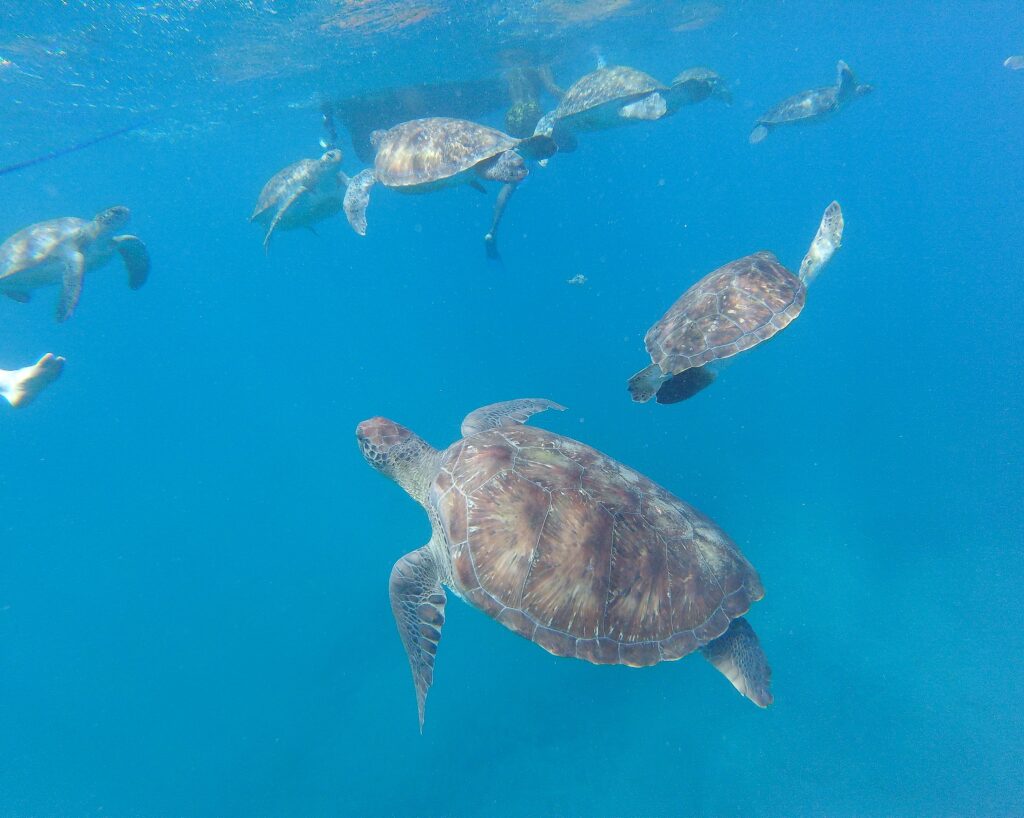
On São Vicente, or during other authorised marine excursions, you may instead see turtles underwater during a guided snorkelling trip.
These experiences happen in different places, at different times and under different rules.
Cape Verde is one of the world’s major nesting areas for loggerhead sea turtles, and Boa Vista holds the largest share of the country’s nesting activity. Sal also supports substantial nesting and offers some of the easiest turtle experiences to combine with a conventional beach holiday.
For travellers planning specifically around nesting females, July to September is the main tourism window, with August usually the strongest month.
Hatchling activity comes later.
In-water turtle observation follows a different calendar again.
Cape Verde introduced detailed national regulations for turtle watching in 2024. They cover night-time beach visits, group sizes, lighting, photography, touching, viewing time and encounters in the sea.
The aim is to let turtles nest, hatch and move through the water with as little disturbance as possible.
Turtle Watching in Cape Verde at a Glance
| Experience | Practical Answer |
|---|---|
| Main nesting species | Loggerhead turtle (Caretta caretta) |
| Best island for dedicated nesting watching | Boa Vista |
| Biological nesting season | June–October |
| General legal visitor window | 15 July–30 September |
| 2026 authorised season reported locally | 1 July–end September, with exclusions on some beaches |
| Peak nesting activity | August |
| Hatchling / emergence period | Mainly late August–November, sometimes early December |
| Best-known turtle snorkelling base | São Pedro, São Vicente |
| Sightings guaranteed? | No |
| Photography | Follow guide instructions; no flash or white light |
| Touching turtles or eggs | Prohibited |
| Feeding wild turtles | Prohibited |
Three Different Turtle Experiences in Cape Verde
The phrase “turtle season” can hide three distinct wildlife experiences.
Watching Adult Turtles Nest
This is the classic night-time excursion.
A female loggerhead comes ashore after dark, crosses the beach, selects a nesting site, digs an egg chamber, lays her eggs and eventually returns to the sea.
Visitors remain under the control of an authorised guide throughout the observation.
The group waits while the turtle reaches the appropriate stage of nesting before moving closer.
Hatchlings and Nest Excavations
Several weeks after eggs are laid, hatchlings begin emerging.
Conservation projects may organise educational activities during this later part of the season, including carefully supervised excavation of nests that have already hatched naturally.
This is very different from staged releases where visitors are invited to handle baby turtles.
Seeing Turtles in the Sea
Cape Verde also offers guided in-water observation.
São Pedro on São Vicente is particularly well known for snorkelling trips where turtles can be observed underwater.
This is a marine wildlife activity with its own rules for distance, group size, interaction time and feeding.
Understanding which experience you want is the first step in choosing the right island and travel dates.
Why Cape Verde Matters for Loggerhead Turtles
Five species of sea turtle have been recorded in Cape Verdean waters:
- loggerhead turtle;
- green turtle;
- hawksbill turtle;
- olive ridley turtle;
- leatherback turtle.
The nesting story is dominated by the loggerhead turtle.
Loggerheads nest regularly in very large numbers across the archipelago, while nesting by some of the other species is rare or occasional.
Cape Verde is one of the world’s most important loggerhead nesting regions.
Boa Vista accounts for roughly three quarters of the country’s nesting activity, with extensive protected beaches used by nesting females each year.
Long-term monitoring has also documented a major recovery in nesting numbers, associated with decades of conservation work, patrols, enforcement and community involvement.
That recovery remains dependent on continued protection.
Nesting beaches still face pressure from artificial lighting, vehicles, coastal development, disturbance, tourism and climate change.
Best Time for Turtle Watching in Cape Verde
There are several dates to understand.
Biological Nesting Season
Cape Verde’s legal framework defines the nesting season broadly as:
1 June to 31 October
Females may come ashore during this wider biological period.
Tourist access is restricted to a shorter authorised window.
Tourist Observation Season
The national regulations establish 15 July to 30 September as the general period for tourist observation on nesting beaches.
Seasonal permissions can vary.
For 2026, Project Biodiversity reported authorised guided observation from 1 July through the end of September, with exclusions on some nesting beaches.
For practical planning, treat:
July–September
as the main season for organised nesting-turtle excursions, and confirm the authorised dates for the year and island you are visiting.
Peak Nesting: August
If nesting turtles are a central reason for the trip, August is usually the strongest single month to choose.
Activity rises substantially during July, reaches a strong peak in August and remains high into September.
Individual sightings still depend on activity on the beach that night.
Hatching Season
Hatchlings begin emerging later.
The main emergence period generally starts from late August and continues through autumn, with conservation activities in some locations extending into November or early December.
Late summer can therefore bring an overlap between adult nesting activity and hatchling-related conservation work.
Boa Vista: The Best Island for Nesting Turtles
For travellers planning a trip specifically around nesting loggerheads, Boa Vista is the strongest choice.
The island contains the largest concentration of nesting activity in the archipelago and some of Cape Verde’s most important protected turtle beaches.
Many of these sites are far from the main resort areas.
A typical evening may include:
- hotel pickup;
- 4×4 transport;
- travel to a remote nesting beach;
- a briefing from the guide;
- waiting away from the turtle;
- walking on soft sand in darkness;
- controlled observation of the nesting process;
- a late return to the hotel.
Tours commonly last around three to four hours.
The remote location is part of the logistics. Important nesting beaches are deliberately protected from excessive lighting, traffic and visitor pressure.
Boa Vista suits travellers willing to dedicate an evening specifically to the experience.
Turtle Watching on Sal
Sal also supports substantial loggerhead nesting and has a well-developed seasonal excursion market.
For travellers staying in Santa Maria, the experience is easy to integrate into an existing holiday.
Typical excursions include:
- hotel pickup;
- transport to a nesting beach;
- guide;
- conservation briefing;
- night-time observation;
- return transfer.
Sal also offers another useful experience later in the season through Project Biodiversity’s Sea Turtle Conservation Hatchery near Santa Maria.
This makes Sal particularly convenient for travellers combining turtle conservation with:
- beaches;
- diving;
- watersports;
- Santa Maria;
- a wider independent holiday.
Boa Vista remains the stronger option for a trip built primarily around nesting turtles.
See Where to Stay in Sal and Things to Do in Sal for the rest of the island.
Maio and Other Nesting Islands
Loggerhead nesting extends beyond Boa Vista and Sal.
Maio is especially important from a conservation perspective and has been identified as a significant nesting refuge.
Tourism there is much smaller.
Its biological importance is therefore greater than its current visitor infrastructure might suggest.
Travellers considering Maio specifically for turtle watching should confirm:
- whether authorised tours are operating;
- which beaches are open to visitors;
- seasonal dates;
- qualified guide availability;
- transport arrangements.
Nesting also occurs on other islands, but organised observation varies considerably.
For most first-time visitors, Boa Vista and Sal remain easier to plan.
What to Expect on a Night Turtle Walk
A responsible turtle excursion involves patience.
After arriving near the nesting beach, the guide normally explains:
- nesting behaviour;
- conservation work;
- how visitors should move;
- lighting rules;
- photography restrictions;
- permitted distance;
- when the group must remain still.
Guides or conservation teams then look for signs of nesting activity.
A female may:
- leave the sea;
- cross the beach;
- search for a suitable location;
- begin digging;
- prepare the egg chamber;
- lay her eggs;
- cover and disguise the nest;
- return to the ocean.
Visitors remain away from the turtle during the early stages.
The guide decides when the group can approach.
Why the Group Has to Wait
The period before egg laying is sensitive.
A female may abandon a nesting attempt if she encounters disturbance while moving across the beach, selecting a site or digging.
Visitors therefore wait until the guide confirms that the turtle has begun laying.
The group then approaches from behind.
You may spend a significant amount of time quietly waiting in darkness before moving closer.
That waiting protects the nesting process.
Cape Verde’s Turtle-Watching Rules
Cape Verde’s 2024 regulations cover both nesting-beach tourism and observation of sea turtles in the water.
They define how visitors, guides, boats and operators should behave.
Group Size and Distance
When observing a nesting female:
- a maximum of 10 visitors may observe one turtle;
- the group must remain at least 1 metre away;
- visitors approach from behind;
- the group stays together;
- noise and movement must be kept low.
The guide determines the group’s position throughout the observation.
Observation Time
A group may observe the same nesting turtle for a maximum of 30 minutes.
A minimum interval is also required before another group approaches the same animal.
These limits reduce repeated disturbance on busy nesting beaches.
Lighting
Artificial light can disturb nesting females and hatchlings.
During an authorised observation, the guide controls the lighting.
Red light may be used under controlled conditions during the appropriate stage of nesting and should never be directed at the turtle’s head.
Visitors should leave lighting to the guide.
White torches, bright phone lights and other artificial lighting should remain off.
Photography
Flash photography is prohibited.
Phone lights, video lights and similar artificial lighting should not be used to improve photographs.
If photography is allowed, follow the guide’s instructions and work with the light available.
A dark beach is part of the experience.
No Touching
Visitors must not touch:
- the turtle;
- eggs;
- hatchlings;
- the nest.
Digging into a nest, opening it or moving eggs is also inappropriate.
Handling by conservation staff is limited to authorised monitoring, protection or animal-welfare work.
What to Wear and Bring
A few practical choices make a night turtle excursion much easier.
Bring or wear:
- dark clothing;
- comfortable footwear for walking on soft sand;
- water;
- a light layer for wind;
- suitable insect protection;
- minimal belongings.
Avoid:
- strong perfume;
- flash photography;
- personal torches unless specifically requested by the guide;
- loud conversation;
- alcohol during the excursion;
- smoking on the nesting beach.
Keep your phone away during the approach unless the guide says it can be used.
Expect darkness, sand and periods of waiting.
Turtle Watching with Children
Turtle watching can be memorable for children, but the practical demands are worth considering.
An excursion may involve:
- a 4×4 transfer;
- rough tracks;
- walking on soft sand;
- darkness;
- long periods of waiting;
- staying quiet;
- returning late.
Boa Vista tours often finish around 23:00 or midnight.
Minimum ages vary between operators.
For families, useful questions are whether the child can:
- stay calm in darkness;
- walk comfortably on sand;
- wait quietly;
- follow the guide’s instructions;
- cope with a late evening.
Sal may offer simpler logistics for some families because many visitors are based close to Santa Maria.
Wildlife Sightings Depend on the Night
Even during peak season, a nesting turtle sighting cannot be guaranteed.
Females come ashore according to their biological cycle, and activity differs between beaches and nights.
A qualified guide improves the quality of the experience through knowledge of nesting sites, tracks and recent activity.
When choosing a tour, prioritise:
- authorised access;
- guide quality;
- group size;
- conservation practice;
- responsible behaviour.
Claims of guaranteed turtle sightings deserve caution.
Turtle-Watching Prices in Cape Verde
Prices vary by island because the logistics are different.
As a November 2026 reference, shared nesting-turtle tours were commonly advertised at approximately:
Sal: €25–€39 per adult
Boa Vista: €55–€65 per adult
Boa Vista tours often involve longer 4×4 transfers to remote nesting areas, which partly explains the difference.
When comparing excursions, check whether the price includes:
- hotel pickup;
- return transport;
- 4×4 transfer;
- guide;
- conservation contribution;
- water;
- insurance;
- cancellation or rebooking conditions.
Prices change between seasons.
The guide, legal access and conservation practices matter more than a small difference in tour price.
Baby Turtles and Hatching Season
Hatchlings begin emerging weeks after the first nests are laid.
From late August onwards, conservation activities may include:
- nest monitoring;
- emergence records;
- educational talks;
- nest excavation;
- collection of survival data.
A hatchling emerging naturally from the sand and moving towards the sea is a vulnerable animal completing an important stage of its life cycle.
Artificial lights, crowds and unnecessary handling can interfere with that process.
Avoid Staged Baby Turtle Releases
Be cautious with tours advertising the chance to hold a baby turtle and release it personally.
Project Biodiversity on Sal does not organise public hatchling releases and advises visitors against excursions that promise them.
During hatching season, its public conservation activities may include nest excavations after the hatchlings have already emerged naturally.
Conservation staff may occasionally need to handle hatchlings for monitoring or welfare purposes.
Visitors should not be invited to pass animals around or release them as part of a staged tourist activity.
Visiting the Turtle Conservation Hatchery on Sal
Project Biodiversity operates a Sea Turtle Conservation Hatchery near the RIU Funana area in Santa Maria.
During the hatching period, generally from late August through autumn and sometimes into early December, visitors may attend public conservation activities.
These can include:
- educational talks;
- explanations of turtle conservation;
- information about nest monitoring;
- excavation of nests that have already hatched.
Public activities are commonly held at around 16:30, although the current schedule should always be checked locally.
The experience is useful for travellers who:
- visit later in the season;
- want to understand the conservation programme;
- are travelling with children;
- prefer an educational activity close to Santa Maria.
Public hatchling releases are not part of the programme.
Swimming with Turtles in Cape Verde
In-water observation is a separate experience from nesting tourism.
Cape Verde regulations allow guided turtle observation in the sea under controlled conditions.
For tourism purposes, the dedicated activity is conducted by snorkelling or breath-hold diving, with rules governing distances, numbers and interaction time.
The aim is to observe turtles while leaving them free to continue swimming, resting or feeding naturally.
São Pedro, São Vicente: The Main Turtle-Snorkelling Base
São Pedro, on São Vicente, is one of Cape Verde’s best-known locations for guided turtle snorkelling.
Trips commonly involve transfer from Mindelo or direct arrival in São Pedro.
Depending on the operator, an excursion may include:
- transfer;
- local boat;
- mask and snorkel;
- life jacket;
- guide;
- safety briefing;
- supervised time in the water.
The full activity often lasts roughly one to two and a half hours, depending on transport and operator.
It can be combined easily with a stay in Mindelo.
See:
for wider planning.
Rules for Snorkelling with Turtles
During authorised in-water turtle observation:
- visitors must remain at least 1.5 metres from the turtle;
- no more than 5 people may be in the water at one observation point;
- interaction is limited to 10 minutes per group;
- entry into the water should be quiet;
- sudden jumps and excessive splashing should be avoided;
- the group should move away if the turtle shows signs of stress.
Boats are also prohibited from actively approaching turtles to within less than 25 metres.
Before booking, ask the operator how it applies these distance, group-size and interaction-time rules.
If a turtle swims away, give it space to leave.
Never Feed Sea Turtles
Feeding wild sea turtles is prohibited in Cape Verde.
Some wildlife experiences use food to attract animals towards swimmers or boats. That practice should not form part of a turtle encounter here.
Feeding alters natural behaviour and can teach animals to associate boats or people with food.
Before booking a snorkelling excursion, ask:
- Do you feed the turtles?
- How do you locate them?
- How many people enter the water at once?
- How long does one group remain with a turtle?
- What distance do you maintain?
- What happens when the turtle swims away?
If an operator uses food to attract turtles, choose another excursion.
Responsible Turtle Tourism
Well-managed turtle tourism can support conservation.
Guided excursions create local employment, generate income connected to living wildlife and can help finance patrols, monitoring and environmental education.
Long-term conservation work on Cape Verde’s nesting islands has contributed to a major increase in loggerhead nesting.
Poorly managed tourism creates additional pressure.
Potential problems include:
- excessive visitor numbers;
- off-road vehicle traffic;
- disturbance of dunes;
- artificial lighting;
- repeated approaches to the same turtle;
- handling hatchlings;
- feeding turtles at sea;
- development close to nesting habitat.
Cape Verde’s recovery story shows what sustained conservation can achieve.
Maintaining that recovery requires continuing to protect the animals and the beaches they depend on.
Turtle Watching and Whale Watching
Cape Verde offers seasonal opportunities for both loggerhead turtles and humpback whales, but their main tourism periods fall at different times.
Humpback Whales
The strongest practical period is around:
March–April
Nesting Loggerhead Turtles
The main visitor period is:
July–September
with August usually the strongest month.
A trip planned around humpback whales will generally be too early for nesting-turtle excursions.
A turtle-focused summer trip will usually fall after the main humpback season.
Travellers interested in both should decide which experience has priority when selecting dates.
See Whale Watching in Cape Verde for the full whale season and planning guide.
Turtle Watching and Diving
Turtle watching can also be combined with diving.
Sea turtles may appear naturally at Cape Verde dive sites, but divers should allow them space to continue swimming, resting or feeding.
Do not chase, corner or touch a turtle underwater.
The same applies to photography.
See Diving in Cape Verde for island comparisons, seasons, dive sites and practical planning.
Turtle Watching on a 7-Day Cape Verde Trip
If nesting turtles are a major priority during a seven-day trip, a relatively simple itinerary gives you more flexibility.
Several nights on Boa Vista or Sal allow:
- more than one possible evening for the tour;
- beach time;
- other island activities;
- room for a schedule change;
- less time lost to inter-island transport.
Boa Vista is the stronger choice for a turtle-focused trip.
Sal integrates more easily into a holiday also centred on Santa Maria, diving or watersports.
See our Cape Verde 7-Day Itinerary for wider planning.
Turtle Watching on a 10- or 14-Day Trip
A longer trip makes it easier to combine nesting turtles with another island.
Possible combinations include:
- Boa Vista + Sal;
- Sal + São Vicente;
- Boa Vista + Santiago;
- Sal + São Vicente + Santo Antão.
A traveller could watch nesting turtles on Sal or Boa Vista and later visit São Vicente for a completely different in-water turtle experience.
Plan the island sequence around current flight schedules and full transfer times.
See:
- Cape Verde 10-Day Itinerary
- Cape Verde 14-Day Itinerary
- Domestic Flights in Cape Verde
before finalising the route.
Boa Vista and Sal Compared for Turtle Watching
For dedicated nesting-turtle watching, Boa Vista has the strongest overall proposition.
It holds the largest share of Cape Verde’s nesting activity and includes extensive protected nesting beaches.
Sal also offers significant nesting activity, easier access from Santa Maria and conservation experiences during the hatching period.
Boa Vista is the stronger option when turtle nesting is one of the main reasons for travelling. Sal fits more naturally into a holiday centred on Santa Maria, diving, watersports, restaurants and independent activities.
See Sal vs Boa Vista for the wider comparison between the islands.
Plan Your Cape Verde Wildlife Trip
Tell us:
- your travel dates;
- number of travellers;
- ages of any children;
- islands you are considering;
- whether you want to see nesting turtles;
- whether hatchling season interests you;
- whether you want to snorkel with turtles;
- whether whale watching is also a priority;
- whether you also want beaches, diving, hiking or watersports;
- how many islands you want to visit.
We can match the wildlife seasons to the wider trip and combine islands, accommodation, transfers, turtle experiences, whale watching and onward travel around the time available.