
Ferries are an important part of travelling between the Cape Verde islands, but their usefulness varies considerably from one route to another.
Some crossings fit naturally into a holiday itinerary. São Vicente and Santo Antão, for example, are linked by a short sea crossing and work particularly well as a two-island combination.
Other ferry journeys take five, ten or even more than thirteen hours and need to be compared with domestic flights before you decide how to structure the trip.
CV Interilhas operates the main inter-island network. Additional operators may serve particular routes, so check the services available for your exact dates.
For current departures, routes and ticket availability, use the official CV Interilhas – Routes & Schedules page.
This guide explains the main ferry possibilities in Cape Verde, how to use the network when planning an island-hopping trip, how tickets and check-in currently work and when flying may save a significant travel block.
Cape Verde Ferries at a Glance
Main inter-island network: CV Interilhas
Islands served by the network: Santo Antão, São Vicente, São Nicolau, Sal, Boa Vista, Maio, Santiago, Fogo and Brava
Best-known short tourist connection: São Vicente ↔ Santo Antão
Tickets: online, ticket office or official partners
CV Interilhas passenger check-in: currently at least 1 hour before departure
Identification: photo ID matching the passenger name on the ticket
Vehicles: carried on suitable services
Schedules: published by travel date and subject to operational changes
Cape Verde’s ferry system gives travellers a wide range of possible island combinations. The important distinction is between a route that exists in the network and a sailing that works efficiently within your itinerary.
Key Cape Verde Ferry Connections
The table below gives an idea of the scale of some important inter-island journeys.
The times are CV Interilhas reference travel times, rather than scheduled journey durations for a particular sailing. Actual departure and arrival times vary according to the service and route.
| Route | Operator Reference Travel Time | Planning Role |
|---|---|---|
| São Vicente ↔ Santo Antão | ~40 min | Short, practical tourist connection |
| Fogo ↔ Brava | ~50 min | Important access route for Brava |
| Santiago ↔ Maio | ~1h45 | Practical when the sailing fits |
| Sal ↔ Boa Vista | ~3h05 | Compare with available flights |
| São Vicente ↔ São Nicolau | ~3h40 | Practical on selected itineraries |
| Santiago ↔ Fogo | ~5h05 | Compare ferry and flight |
| Sal ↔ Santiago | ~9h40 | Major travel block |
| Sal ↔ São Vicente | ~9h55 | Major travel block |
| São Vicente ↔ Santiago | ~13h20 | Very long for a short holiday |
These reference times show how varied ferry travel in Cape Verde can be.
A short crossing between São Vicente and Santo Antão has a completely different planning impact from a sea journey lasting ten or thirteen hours.
Use the table to understand what may be possible, then use the current timetable to build the trip around the sailing that actually operates on your dates.
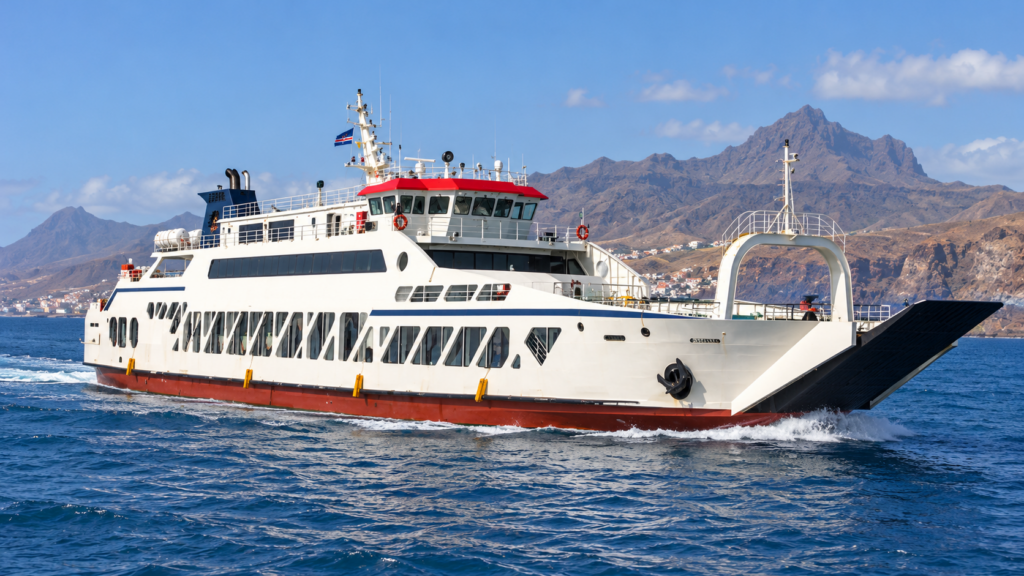
São Vicente to Santo Antão
The São Vicente–Santo Antão ferry is one of the easiest maritime connections to include in a Cape Verde itinerary.
Ferries connect Mindelo on São Vicente with Porto Novo on Santo Antão.
CV Interilhas publishes a reference travel time of around 40 minutes, while individual schedules may show closer to an hour between departure and arrival.
The route is central to travel between the islands and makes São Vicente and Santo Antão an efficient combination for a short or longer trip.
São Vicente offers Mindelo, music, urban culture, beaches and dry volcanic scenery.
Santo Antão adds mountain roads, agricultural valleys, villages and hiking.
After reaching Porto Novo, include the onward road journey when planning your day. Travellers staying in Paul, Ribeira Grande, Ponta do Sol or other parts of the north and northeast still have a road transfer ahead.
For a complete example, see our São Vicente + Santo Antão: 7-Day Itinerary.
For destination planning, see our São Vicente Travel Guide and Santo Antão Travel Guide.
Our dedicated How to Get to Santo Antão from São Vicente guide will cover the ports, ferry journey, road transfers and timing in greater detail.
Plan São Vicente & Santo Antão
Fogo to Brava
Fogo and Brava form another short maritime pairing.
CV Interilhas publishes a reference travel time of around 50 minutes between the two islands.
For trip planning, the sailing time is only one part of the decision. The departure must also fit your arrival on Fogo, your accommodation and the onward structure of the journey.
If you are reaching Fogo by air or ferry and then continuing to Brava, check the operating day and departure time before fixing the number of nights on each island.
Allow enough time on Fogo for São Filipe, Chã das Caldeiras or Pico do Fogo if those experiences are part of your plans.
See our Fogo Travel Guide for destination planning.
Santiago to Maio
The reference journey time between Santiago and Maio is around 1 hour 45 minutes.
That makes it a relatively short crossing in Cape Verde terms.
Its usefulness still depends on when the ferry operates. A convenient crossing time only helps when the sailing fits the dates and direction of your itinerary.
Check the outbound and return services before committing accommodation around Maio.
Santiago to Fogo
The reference travel time between Santiago and Fogo is around 5 hours 5 minutes.
At this length, the ferry becomes a significant part of the travel day.
Compare the complete sea journey with the domestic flight available on your dates.
Consider:
- departure and arrival times;
- transfer time to the port or airport;
- check-in requirements;
- baggage;
- transport after arrival;
- the overall cost;
- how much usable time each option leaves on the destination island.
A five-hour ferry can fit perfectly into one itinerary and consume too much time in another.
See Domestic Flights in Cape Verde to compare the air network with longer ferry connections.
Ferries between Sal, Boa Vista, São Nicolau and São Vicente
The northern and eastern islands are served within wider ferry rotations rather than by a simple frequent shuttle between every pair.
Reference travel times include:
- Sal ↔ Boa Vista: around 3h05;
- São Vicente ↔ São Nicolau: around 3h40;
- Sal ↔ São Nicolau: around 7h10;
- Sal ↔ São Vicente: around 9h55;
- Boa Vista ↔ São Vicente: around 10h50.
These figures are useful for understanding the network, but the practical route depends on the timetable for your dates.
For Sal + Boa Vista, compare the available ferry with the flight options and the amount of travel time each requires.
For São Vicente + São Nicolau, the shorter sea journey can make the ferry more attractive when the sailing fits the itinerary.
For a broader overview of transport between the islands, see How to Get Around Cape Verde.
Ferry or Domestic Flight?
The better option depends on the islands, the available sailing or flight and the total travel block.
| Ferry Often Makes Sense When… | Compare Carefully with a Flight When… |
|---|---|
| It is the normal access route to the island | Both islands have airports |
| The crossing is short | The sea journey takes many hours |
| Departure time fits the itinerary | Most of a usable day goes into travel |
| You need to transport a permitted vehicle | Flying removes a major travel block |
| Two islands form a natural geographical pair | The ferry creates awkward sequencing |
| The sea journey fits comfortably into the trip | An international connection depends on the next leg |
São Vicente → Santo Antão clearly favours the ferry.
Santiago → Fogo deserves a genuine comparison between sea and air.
For routes such as São Vicente → Santiago, a reference ferry journey of more than thirteen hours makes the overall itinerary particularly important.
Compare the complete journey rather than choosing purely by ticket price.
How to Check the Current Cape Verde Ferry Timetable
Plan ferry travel around the dates you will actually travel.
CV Interilhas publishes routes and upcoming departures online.
A useful sequence is:
- choose the islands you want to connect;
- open the timetable for your travel dates;
- check both the departure and arrival time;
- confirm the return or onward sailing;
- calculate transfers to and from the ports;
- then book accommodation and activities that depend on the connection.
Check both directions.
A sailing that works perfectly on the outward journey may be less convenient on the date you need to return.
For current departures and routes, use the official CV Interilhas – Routes & Schedules page.
Buying Cape Verde Ferry Tickets
CV Interilhas currently sells passenger tickets through its website, ticket offices and official partners.
Buy the ticket before boarding.
For current availability and online booking, use the official CV Interilhas website.
Additional ferry operators may use their own booking systems. Cape Verde’s official tourism information currently identifies Nôsferry and Polaris on selected services, so check which operator is running the journey you intend to use and follow its current booking rules.
Check the Passenger Name
CV Interilhas currently requires passengers to present photographic identification.
The passenger name on the identification document must match the name on the ticket.
Use the correct document details when making the reservation.
Check-in and ID Requirements
Under the current CV Interilhas passenger rules, travellers should check in at least one hour before departure.
Passengers also need a photo identification document, such as a passport or national ID card, together with the ticket.
Treat the ferry as a complete travel block:
hotel → port → check-in → boarding → ferry → disembarkation → onward transfer
That total time is more useful for itinerary planning than the crossing duration alone.
Check the operator’s current requirements again before travel, particularly if your trip is still several months away.
Baggage on CV Interilhas Ferries
CV Interilhas currently publishes separate allowances for hand and checked baggage.
| Baggage Type | Current CV Interilhas Published Allowance |
|---|---|
| Hand luggage | Up to 2 items, each max. 55 × 40 × 25 cm and 8 kg |
| Checked baggage | Up to 2 items, each max. 33 × 55 × 85 cm and 25 kg |
Oversized or heavier baggage may require approval or additional payment.
If you are travelling with sports equipment, large cases or unusual items, consult the operator before the travel day.
For the latest limits and procedures, see the official CV Interilhas Passenger & Baggage Rules.
Taking a Car on a Cape Verde Ferry
CV Interilhas carries vehicles on suitable services and currently requires a separate vehicle ticket.
Standard vehicles must currently be presented for boarding at least one hour before departure, while freight vehicles have an earlier deadline.
For rental cars, check the rental agreement before reserving vehicle space. The rental company decides whether the vehicle may leave the island where it was hired.
In some itineraries, arranging another vehicle, taxi or private transfer after arriving on the next island is simpler than moving the same car between islands.
This is particularly relevant when combining São Vicente and Santo Antão.
Weather, Schedule Changes and Travel Buffers
Ferry schedules can change because of weather, sea conditions or operational requirements.
Cape Verde’s official tourism information advises travellers to check current maritime services, particularly because meteorological and oceanographic conditions can affect operations.
Build extra margin around connections that matter most.
This is especially useful when a ferry is followed by:
- an international flight;
- a domestic flight;
- another ferry;
- a fixed activity that would be difficult to move.
Leaving margin before an international flight or another critical connection reduces the chance that one schedule change affects the rest of the itinerary.
In our São Vicente + Santo Antão: 7-Day Itinerary, for example, the recommended route returns to Mindelo the day before the international departure.
Seasickness and Atlantic Crossings
Sea conditions vary according to route, vessel, season and the weather on the day.
Travellers who are prone to motion sickness may want to prepare before boarding, particularly for longer crossings.
For a long ferry journey:
- eat appropriately before departure;
- stay hydrated;
- follow crew instructions about passenger areas;
- have any motion-sickness treatment you normally use available before boarding;
- leave some recovery time after the crossing if you know sea travel affects you.
Atlantic conditions can vary from one day to the next, even on the same route.
What to Book First for a Ferry-Based Island Trip
For a multi-island journey, start with the transport that determines the route.
A practical order is:
- International flights — establish where the trip begins and ends.
- Critical ferry or domestic flight connection — determine the island sequence.
- Ferry tickets — once the relevant sailing is available and bookable.
- Accommodation — allocate nights around confirmed transport.
- Port and airport transfers — particularly where arrival requires a longer road journey.
- Fixed activities — guided hikes, island tours, diving or experiences tied to specific days.
For a simple route such as São Vicente + Santo Antão, this process is relatively straightforward.
Longer journeys involving Sal, Santiago, Fogo or São Nicolau may require several flight and ferry combinations to be compared before the final allocation of nights.
Planning Cape Verde Island Hopping with Ferries
Ferries can play an important role in an island-hopping trip without being used for every connection.
A journey might combine:
international flight → ferry → ferry → domestic flight
or:
international flight → domestic flight → ferry → international flight
Choose each leg according to the geography, timetable and time available.
São Vicente + Santo Antão
The ferry is the natural connection.
See São Vicente + Santo Antão: 7-Day Itinerary.
Santiago + Fogo
Compare the ferry with the domestic flight for your travel dates.
Fogo + Brava
The maritime connection is central to the route, so place the actual sailing into the itinerary before fixing the surrounding nights.
Sal + Boa Vista
A ferry may fit the journey, but compare its timing with the available flights before deciding how to divide your stay.
Longer Multi-Island Trips
For our Cape Verde 10-Day Itinerary and Cape Verde 14-Day Itinerary, use ferries where they create an efficient connection and flights where they save a major travel block.
Plan Your Cape Verde Island-Hopping Trip
Some Cape Verde ferry routes fit naturally into an island-hopping trip; others require a real comparison with domestic flights.
Start with your dates and islands, then build accommodation and activities around the connections that work.
Tell us:
- your travel dates;
- your international flights, if already booked;
- the islands you want to visit;
- how much time you have;
- whether you prefer ferries, flights or the most efficient combination;
- the activities you want to include.
We can organise the route, ferry and flight connections, accommodation, airport and port transfers, local transport, guides and experiences around the connections available for your trip.