
A strong Cape Verdean national identity takes visibly different forms from island to island.
The language changes.
Music changes.
Festivals change.
Mindelo has a different cultural rhythm from Praia. Rural Santiago preserves traditions that feel quite different from those of Santo Antão. São João in Porto Novo, Carnival in Mindelo and Tabanca on Santiago all belong to the same country while revealing different parts of its cultural history.
Understanding Cape Verde culture therefore requires more than learning a few familiar words such as morabeza, morna and cachupa.
Its roots lie in the formation of a Creole society in the Atlantic, the development of Kriolu, centuries of migration, music, religion, family networks and the movement of people between the islands and the diaspora.
Culture is also part of ordinary life.
You hear it in conversation, cafés, local festivals, markets, music venues, churches, football discussions and family gatherings.
Cape Verde Culture at a Glance
| Topic | Practical Overview |
|---|---|
| Official language | Portuguese |
| Main everyday language | Cape Verdean Kriolu |
| Does Kriolu vary by island? | Yes — pronunciation, vocabulary and forms differ |
| Best-known musical genre | Morna |
| Other important traditions | Batuque, funaná, coladeira, colá São João |
| Major cultural city | Mindelo, São Vicente |
| Key historical site | Cidade Velha, Santiago |
| Major Carnival | Mindelo Carnival |
| Major June festival | São João, especially Porto Novo |
| Largest religious tradition | Roman Catholicism |
| Important cultural idea | Morabeza — hospitality, warmth and welcome |
| Role of the diaspora | Central to family, music, identity and celebrations |
| Best approach | Observe, learn and participate respectfully |
How Cape Verdean Culture Developed
There is no evidence of a permanent pre-Portuguese population on the Cape Verde islands.
Portuguese settlement began in the fifteenth century, with Santiago becoming the first major centre.
Its position between West Africa, Europe and the Atlantic shipping routes soon gave Cape Verde an important role in trade and in the trafficking of enslaved Africans.
That history shaped the society that followed.
Cape Verdean culture developed through colonial rule, forced migration, African cultural continuity, European institutions, religion, Atlantic trade and centuries of local adaptation.
Language, music, food and social identity emerged from those conditions over generations.
Cape Verde became independent from Portugal on 5 July 1975.
The modern republic is relatively young, while the cultural roots of Cape Verdean society stretch back centuries.
Cidade Velha and the Birth of a Creole Society
Anyone interested in Cape Verdean history should understand the importance of Cidade Velha, on Santiago.
Originally known as Ribeira Grande, it became the first European colonial town built in the tropics.
Its strategic position made it a major point in Atlantic trade and in the trafficking of enslaved Africans.
It was also one of the places where an early Creole society developed.
Cidade Velha is therefore much more than a collection of historical buildings near Praia.
Its streets, churches, fortifications and archaeological remains connect modern Cape Verde with the difficult history from which its society emerged.
Today, Cidade Velha is a UNESCO World Heritage Site.
See Things to Do in Santiago when planning a visit.
Kriolu: The Language of Everyday Cape Verde
Portuguese is the official language of Cape Verde.
Cape Verdean Kriolu is the language of much everyday life and the mother tongue of most Cape Verdeans.
It developed historically through contact between Portuguese and African languages during the formation of Cape Verdean society.
Today, Kriolu is used in:
- family conversation;
- friendships;
- music;
- humour;
- informal business;
- radio and media;
- literature;
- cultural and political discussion.
Portuguese remains central to administration, education, formal communication and much written public life.
Portuguese dominates official contexts; Kriolu dominates much everyday conversation.
Portuguese and Kriolu
Visitors can manage many situations in Portuguese.
English, French and other European languages are also spoken in the main tourism areas.
A few words of Kriolu, however, often change the tone of an interaction because they show interest in the language people actually use with one another.
The relationship between Portuguese and Kriolu is also part of an ongoing cultural and political discussion.
The Constitution establishes Portuguese as the official language and requires the State to promote conditions for the officialisation of Cape Verdean in parity with Portuguese.
The debate therefore reaches beyond translation.
It touches identity, education, literature and the way Cape Verdeans understand their own cultural history.
Why Kriolu Changes Between Islands
Kriolu varies across the archipelago.
A broad distinction is often made between:
Sotavento varieties
- Santiago;
- Fogo;
- Maio;
- Brava.
and:
Barlavento varieties
- Santo Antão;
- São Vicente;
- São Nicolau;
- Sal;
- Boa Vista.
Differences can be immediately noticeable between islands such as Santiago and São Vicente.
Pronunciation, vocabulary, rhythm and grammatical forms may change.
That also explains why the same expression can appear with different spellings online or sound different from one island to another.
The Alfabeto Cabo-Verdiano, based on the ALUPEC writing system, provides a standardised framework for writing Cape Verdean.
Variation remains part of the language as it is spoken.
Useful Kriolu Words
Spelling and pronunciation vary between islands, so treat these as useful examples rather than a universal phrasebook.
| Expression | Meaning |
|---|---|
| Bon dia | Good morning |
| Boa tardi | Good afternoon |
| Obrigadu / Brigadu | Thank you |
| Modi ki bu sta? | How are you? |
| Sta dretu | All good / everything is fine |
Portuguese greetings are also widely understood.
A simple greeting before asking a question is usually a good start.
Morabeza: Hospitality and Social Warmth
Few words appear more often in descriptions of Cape Verde than morabeza.
It is associated with:
- hospitality;
- warmth;
- friendliness;
- attentiveness;
- making others feel welcome.
Tourism marketing sometimes turns morabeza into a description of Cape Verdeans as if everyone shared the same personality.
Its cultural meaning is more useful when understood as an ideal of hospitality and social warmth.
Visitors participate in morabeza through reciprocity: greeting people, showing patience, accepting hospitality graciously and treating friendliness as a social exchange.
That leaves space for something obvious but important.
Cape Verdeans are individuals.
Cape Verdean Music
Music is one of the clearest ways to experience the diversity of Cape Verdean culture.
Morna is the genre best known internationally, helped enormously by artists such as Cesária Évora.
The musical landscape is much broader.
Morna, batuque, funaná, coladeira and colá São João reflect different histories, rhythms, islands and social settings.
Morna
Morna is one of Cape Verde’s most recognised cultural expressions.
In 2019, UNESCO added it to the Representative List of the Intangible Cultural Heritage of Humanity.
Morna combines poetry, melody, voice, instrumental accompaniment and, traditionally, dance.
String instruments such as guitar, violin and cavaquinho commonly feature in its accompaniment.
Lyrics may explore:
- love;
- separation;
- migration;
- distance;
- memory;
- everyday life;
- departure and return.
The concept of sodade is closely associated with morna.
It can express absence, longing and emotional distance, themes with particular resonance in a country shaped by emigration.
Morna has a much wider emotional range than melancholy alone.
Mindelo is one of the best places to encounter it as part of a living musical culture.
See Mindelo Travel Guide.
Batuque
Batuque, also written batuku, has especially deep roots on Santiago.
It brings together rhythm, voice, poetry and dance.
Women have traditionally played a central role in performance.
A seated group creates the rhythmic foundation through clapping and txabeta percussion while voices and dancers build the performance.
Songs can address:
- everyday life;
- relationships;
- community affairs;
- social commentary;
- personal experience.
Batuque is also an important example of African cultural continuity within Cape Verdean society.
Funaná
Funaná is strongly associated with rural Santiago.
Its sound is driven by instruments such as the gaita, a diatonic accordion, and the ferrinho, a scraped iron instrument.
Long associated with Santiago’s interior, funaná later gained far wider national and international visibility.
In 2024, it was classified as Cape Verdean National Intangible Cultural Heritage.
Its energetic rhythm makes it one of the country’s most immediately recognisable dance traditions.
Coladeira
Coladeira is another major Cape Verdean musical genre.
It is generally more rhythmically lively than morna and strongly associated with dancing and social occasions.
Lyrics can be humorous, playful, satirical or centred on everyday relationships.
Musicians regularly move between styles, and Cape Verdean music continues to absorb influences from the islands, the diaspora and international genres.
Colá São João
Colá São João, or kolá san jon, brings music and dance directly into the religious and popular celebrations of Saint John.
It is especially visible during São João festivities in places such as Porto Novo on Santo Antão.
Religion, music, food and community celebration overlap naturally in these events.
Festivals and Celebrations in Cape Verde
Festivals offer some of the best opportunities to experience Cape Verdean culture in public life.
Some are religious.
Others are civic or seasonal.
Many combine worship, music, food, dance, family gatherings and community identity.
Festival dates and programmes can change from year to year, so confirm the schedule before booking a trip around a specific event.
Mindelo Carnival
The Carnival of Mindelo, on São Vicente, is the best-known Carnival celebration in Cape Verde.
The city spends months preparing:
- costumes;
- music;
- floats;
- choreography;
- group performances.
During Carnival, the streets fill with organised groups, parades, elaborate costumes, music, dancing and neighbourhood participation.
The timing follows the Christian calendar and usually falls in February or March.
Brazilian Carnival has influenced some elements of the modern celebration, but Mindelo has developed its own Carnival culture rooted in the city’s neighbourhoods, music and social life.
For travellers interested in Cape Verdean culture, Carnival can justify planning the trip around São Vicente.
Accommodation should be booked well ahead.
The Mandingas of Mindelo
One of the most distinctive visual traditions associated with the Carnival cycle in Mindelo is the appearance of the Mandingas.
Groups are particularly associated with neighbourhoods such as Ribeira Bote and form part of São Vicente’s Carnival identity.
The tradition includes:
- black-painted bodies;
- costumes;
- procession;
- drumming;
- public performance.
Its local history is complex.
Simple descriptions of the Mandingas as representations of “African warriors” miss much of that context.
They are better approached as a living cultural tradition within Mindelo’s own Carnival history.
São João
The festival of São João Baptista, celebrated around 24 June, has important expressions on several islands.
One of the most prominent takes place in Porto Novo, Santo Antão.
The celebration may include:
- religious devotion;
- pilgrimage;
- procession;
- music;
- dance;
- food;
- horse racing;
- community gatherings;
- Colá São João.
The São João festivities were classified as Cape Verdean National Intangible Cultural Heritage in 2017.
The festival shows how a religious calendar can become part of a much broader community celebration.
Expressions also vary between islands and towns.
Tabanca
Tabanca is one of Santiago’s most distinctive cultural traditions.
It combines:
- religious devotion;
- community organisation;
- music;
- processions;
- food;
- collective participation;
- symbolic roles and hierarchy.
Tabanca groups are usually linked to patron saints and specific communities.
Celebrations can include drumming, processions, batuque and communal meals.
The tradition also reveals the importance of the diaspora.
Cape Verdeans living abroad may send financial support, return for celebrations or maintain active ties with the groups and communities from which they or their families came.
Tabanca has been Cape Verdean National Intangible Cultural Heritage since 2019.
Religion and Community Life
Roman Catholicism remains the largest religious tradition in Cape Verde.
According to the 2021 Census, about 72.5% of residents aged 15 and over identified as Catholic.
The country also includes:
- Protestant churches;
- Seventh-day Adventists;
- Nazarene communities;
- other Christian denominations;
- Muslim communities;
- other religious traditions;
- people with no religion.
Religion appears in churches, family celebrations, patron-saint festivals, processions and public holidays.
Popular celebrations may combine formal religious practice with music, food, dance and community traditions.
Churches and religious events remain active community spaces.
Migration, Diaspora and Cape Verdean Identity
Emigration has shaped Cape Verdean culture for generations.
Cape Verdeans have moved abroad for work, education, family and opportunity, creating large communities in countries including:
- Portugal;
- the United States;
- France;
- the Netherlands;
- Luxembourg;
- Italy;
- Senegal;
- Angola.
The diaspora continues to influence daily life on the islands.
Families may have close relatives abroad.
Money, music, language, fashion and ideas move in both directions.
People return for:
- holidays;
- weddings;
- funerals;
- religious festivals;
- Carnival;
- family visits;
- retirement.
This movement is visible in houses, music, family networks and community celebrations.
Cape Verdean culture extends well beyond the physical archipelago.
Sodade
The word sodade is closely associated with Cape Verdean music and identity.
It is related to the Portuguese saudade and carries particular resonance in a country shaped by migration and separation.
It can express:
- longing;
- absence;
- memory;
- separation;
- attachment to home;
- hope of return.
The word became internationally familiar through Cape Verdean music, particularly morna.
Its meaning becomes clearer when connected to the history of emigration.
For many Cape Verdean families, departure and return are part of lived experience.
Culture in Craft and Everyday Objects
Cape Verdean culture also exists in objects, skills and everyday work.
On Santiago, for example, the pottery tradition of Fonte Lima has long been associated with local women artisans and the production of practical and decorative ceramics.
Markets, woven objects, musical instruments, clothing and handmade goods provide another layer of cultural expression alongside music and festivals.
The value lies in the people and skills behind the objects.
When buying directly from local artisans, ask about how and where the item was made.
Cape Verde Culture by Island
Cape Verde has a shared national culture, but each island expresses parts of it differently.
Santiago
Santiago is central to Cape Verde’s historical and cultural story.
Cidade Velha connects the island to the beginnings of colonial settlement and the formation of Creole society, while Praia brings together markets, neighbourhood life and the country’s largest urban population.
Santiago also has particularly strong links to batuque, funaná and Tabanca.
For travellers interested in history and traditions with deep African continuities, it deserves substantial time.
São Vicente
Mindelo gives São Vicente one of the most visible urban cultural identities in the archipelago.
Live music, morna, coladeira, Carnival, cafés, literature and nightlife all form part of the city’s cultural life.
It is one of the easiest places to experience Cape Verdean music as part of an ordinary evening.
See São Vicente Travel Guide, Mindelo Travel Guide and Things to Do in São Vicente Beyond Mindelo.
Santo Antão
Santo Antão adds a strongly rural dimension.
Village life, agriculture, São João, Colá São João, sugar cane and grogue all connect culture closely to the landscape.
Walking through Paul or another agricultural valley also gives visitors a view of everyday island life beyond formal cultural attractions.
See Santo Antão Travel Guide and Best Hikes in Santo Antão.
Fogo
Fogo’s cultural identity is inseparable from its volcanic landscape.
São Filipe, Chã das Caldeiras, wine, coffee, agriculture, religious festivals and emigration all form part of the island’s story.
Pico do Fogo is both a physical landmark and a powerful presence in local life.
See Things to Do in Fogo and Pico do Fogo Hike.
Sal
Sal has one of the country’s largest tourism economies, alongside its own communities, neighbourhoods and local cultural life.
Santa Maria combines tourism with restaurants, music, churches and residential areas, while Espargos provides a different view of everyday island life.
Spending time beyond the resort environment gives a broader picture of the island.
See Sal Travel Guide and Things to Do in Sal.
Boa Vista
Boa Vista also combines large resort areas with local town life.
Sal Rei offers restaurants, churches, community spaces and everyday routines that can be easy to miss during a resort-only stay.
The island has its own musical and historical traditions alongside its better-known beaches.
São Nicolau
São Nicolau receives fewer international visitors and operates at a different scale from the major tourism islands.
Ribeira Brava, Carnival traditions, rural communities, religious festivals and emigration all contribute to its cultural identity.
Brava
Emigration has played a major role in Brava’s history and family networks.
The island is also associated with music, poetry, São João celebrations and small-town community life.
More complicated transport links keep visitor numbers relatively low, but Brava remains culturally important within the archipelago.
Food as Culture
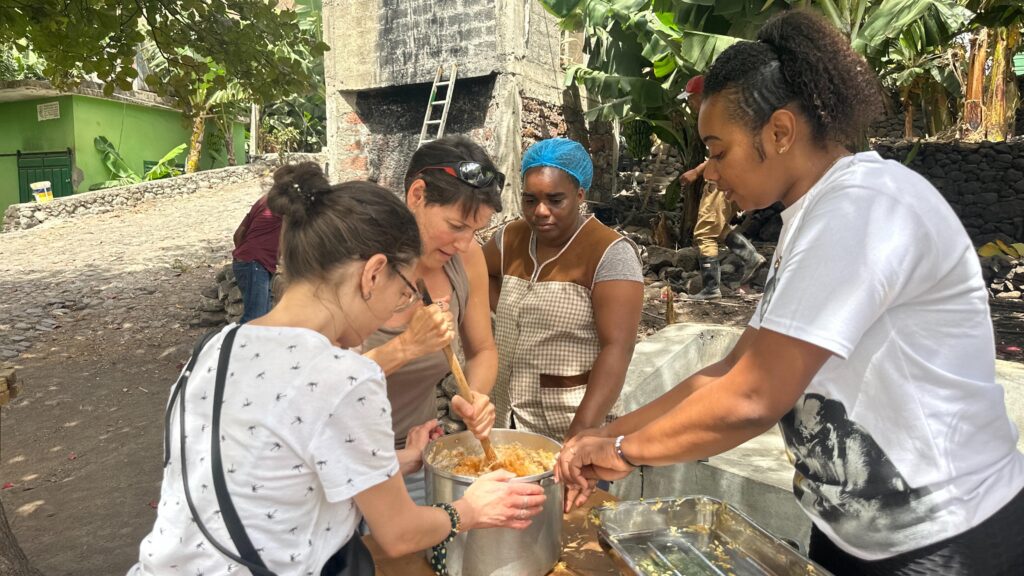
Food is one of the easiest ways to encounter Cape Verdean culture directly.
Cachupa is part of that story, alongside:
- maize traditions;
- fresh fish;
- cuscuz;
- xerém;
- djagacida;
- goat cheese;
- grogue;
- Fogo wine;
- local markets;
- breakfast habits;
- family cooking.
Food also reveals geography.
Santo Antão’s sugar cane tells a different story from Fogo’s vineyards or Santiago’s maize traditions.
For a detailed guide, see Cape Verde Food Guide.
Practical Etiquette for Travellers
Cape Verde is generally easy to navigate socially.
A few habits help interactions feel more natural.
Greet People First
Starting with bom dia, boa tarde or a Kriolu greeting before asking a question is polite and often appreciated.
This is useful in:
- small shops;
- villages;
- cafés;
- markets;
- offices;
- informal conversations.
Ask Before Taking Close Portraits
A public street scene is different from a close portrait.
Ask permission before photographing:
- individuals at close range;
- children;
- workers;
- market vendors;
- religious participants;
- people inside private spaces.
Public festivals are still filled with real people rather than scenery.
Dress Appropriately in Churches
Cape Verde is generally relaxed about clothing in everyday tourist settings.
Churches, funerals, ceremonies and some community events call for more respectful dress.
Beachwear belongs on the beach.
Do Not Assume Everyone Speaks English
English is widely used in some tourism areas.
Portuguese and Kriolu become much more useful elsewhere.
A few words of Portuguese or Kriolu can make everyday interactions easier.
Photography and Respect
Cape Verde is highly photogenic.
Colourful towns, volcanic landscapes, fishing boats, markets, music and festivals naturally attract cameras.
The main distinction is between photographing a public environment and entering someone’s private space.
Ask before taking close portraits.
During religious or community events, follow the flow of the event and avoid blocking processions or performances.
Take extra care when photographing children.
If someone declines a photograph, accept the answer immediately.
How to Experience Cape Verdean Culture
Ordinary travel already offers many opportunities to experience local culture.
Consider:
- spending an evening listening to live music in Mindelo;
- visiting Cidade Velha with historical context;
- exploring Praia’s markets and neighbourhoods;
- eating in local restaurants;
- learning a few words of Kriolu;
- attending a local festival when the dates align;
- visiting markets early in the day;
- spending time outside resort areas on Sal or Boa Vista;
- combining Santo Antão hiking with villages and agricultural landscapes;
- visiting Chã das Caldeiras and São Filipe on Fogo;
- buying directly from local artisans;
- watching community celebrations respectfully.
Culture becomes easier to understand when it is connected to real places, people and everyday life.
Cape Verde Culture on a 7-Day Trip
Seven days is enough to experience meaningful cultural differences if the itinerary remains relatively simple.
Santiago
A culture-focused stay can combine:
- Praia;
- Cidade Velha;
- markets;
- local food;
- music;
- rural Santiago;
- batuque or funaná when events are available.
São Vicente + Santo Antão
This combination provides a strong contrast.
São Vicente brings Mindelo, live music, Carnival traditions and urban cultural life.
Santo Antão adds rural communities, agriculture, village life, São João traditions and grogue.
Sal
A Sal-based trip can still include cultural experiences.
Spend time in Santa Maria beyond the resort environment and visit Espargos if the itinerary allows.
Local restaurants, markets, music venues and residential areas provide a broader view of the island.
See Cape Verde 7-Day Itinerary for route ideas.
Cape Verde Culture on a 10- or 14-Day Trip
A longer journey makes the cultural differences between islands easier to experience.
A route such as:
Santiago → São Vicente → Santo Antão
can combine:
- Cape Verde’s early colonial history;
- different forms of Kriolu;
- batuque and funaná;
- Mindelo’s music;
- rural northern island life.
Adding Fogo introduces another cultural identity shaped by volcanic landscape, agriculture, wine, coffee and migration.
Sal or Boa Vista add the contrast of major international tourism areas alongside local island communities.
See:
- Cape Verde 10-Day Itinerary
- Cape Verde 14-Day Itinerary
- Domestic Flights in Cape Verde
- Cape Verde Ferries
before building the route.
Plan Your Cape Verde Culture Trip
Tell us:
- your travel dates;
- number of travellers;
- islands you are considering;
- how many islands you want to visit;
- whether history is important to you;
- whether you want live music;
- whether festivals are a priority;
- whether you are interested in food, markets or crafts;
- whether you also want hiking, beaches or wildlife;
- your preferred accommodation style.
We can combine islands, accommodation, transfers, history, music, food, markets, festivals and local experiences around the time available.